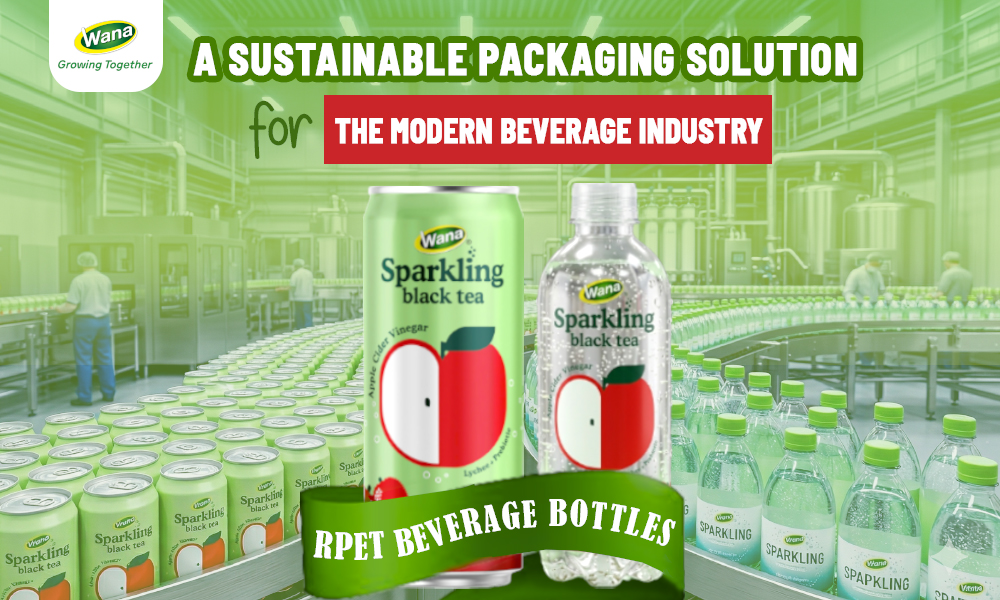
What are rPET beverage bottles?
rPET (recycled polyethylene terephthalate) is post-consumer PET plastic that has been collected, processed, and recycled into new materials—most commonly used in beverage bottle production. As the beverage industry rapidly shifts toward sustainability, rPET beverage bottles are becoming a preferred choice for many global brands.
Unlike virgin plastic, rPET bottles significantly reduce plastic waste while conserving fossil resources during production. This makes them a key driver in building a more sustainable packaging ecosystem within the beverage industry.
How to produce rPET beverage bottles?
To produce food-grade rPET bottles, the recycling process must meet strict quality and safety standards:
Collection and sorting
Used PET bottles are collected from various sources, including return systems, recycling facilities, and deposit programs.
Cleaning and shredding
The bottles are thoroughly cleaned to remove contaminants, then shredded into small flakes.
Recycling and purification
These PET flakes undergo thermal and chemical treatments to eliminate impurities, ensuring they meet food-grade standards.
rPET pellet production
The purified material is converted into rPET pellets, which serve as raw material for new bottle manufacturing.
Bottle manufacturing
The rPET pellets are used to produce recycled PET bottles through blow molding, similar to conventional plastic bottle production.
This process not only enables resource reuse but also significantly reduces carbon emissions compared to virgin plastic production.
What Are The Benefits of rPET beverage bottles?
Reduced environmental impact
One of the biggest advantages of rPET beverage bottles is their ability to minimize plastic waste. By reusing materials, they reduce the demand for new plastic production and ease environmental pressure.
Energy and resource efficiency
Compared to virgin PET, producing rPET bottles requires significantly less energy. This contributes to lower CO₂ emissions and more efficient use of natural resources.
Stronger ESG and brand positioning
Companies that adopt sustainable packaging solutions like rPET are often viewed more favorably in terms of environmental and social responsibility. This not only enhances brand image but also appeals to modern consumers who prioritize eco-friendly products.
Compliance with global regulations
Many countries are introducing strict requirements on recycled content in packaging. Using recycled PET bottles helps businesses meet these standards more easily, especially in export markets.
Pros and Cons of rPET Beverage Bottles
Pros
- Supports circular packaging
- Reduces dependence on virgin plastic
- Lightweight and transport-efficient
- Suitable for many beverage applications
- Supports sustainability positioning
Considerations
- Recycled material availability can vary
- Cost may fluctuate
- Appearance can differ depending on recycled content
- Food-grade requirements must be carefully managed
- Not every beverage or filling process has identical packaging requirements
Read more: How to Navigate EPR Beverage Packaging Regulations in 2026
Applications of rPET in the beverage industry
Today, rPET beverage bottles are widely used across various product categories, including:
🔹Bottled water
🔹Fruit juices
🔹Carbonated soft drinks
🔹Ready-to-drink tea and coffee
🔹Sports beverages
Major brands such as Coca-Cola, PepsiCo, and Nestlé have committed to increasing the use of rPET in their packaging, signaling that this is no longer just a trend but a new industry standard.
Food-grade rPET: A critical requirement for beverages
Not all recycled plastics are suitable for food and beverage applications. To be used in rPET beverage bottles, the material must undergo strict processing to ensure complete safety for consumers.
Food-grade rPET complies with international standards such as FDA (U.S.) and EFSA (Europe). It involves advanced “super-clean” recycling processes that remove contaminants, odors, and any substances that could affect product quality.
This is especially important in the beverage industry, where packaging comes into direct contact with consumable products. Using certified food-grade rPET not only ensures safety but also builds trust with both partners and consumers.
In addition, leading brands prioritize certified recycled PET bottles to maintain transparency and comply with regulations in demanding export markets.
rPET vs. virgin PET: Which is the better choice?
When choosing between rPET beverage bottles and virgin PET, businesses need to consider multiple factors, including environmental impact, cost, and performance.
| Factor | rPET | Virgin PET |
|---|---|---|
| Recycled Content | Yes | No |
| Environmental Impact | Generally lower | Higher reliance on virgin resources |
| Carbon Footprint | Potentially lower | Generally higher |
| Appearance | May vary depending on recycled content | High clarity |
| Cost | Can fluctuate | More predictable |
| Sustainability Positioning | Strong | Limited |
| Regulatory Alignment | Supports recycled-content targets | May face increasing regulatory pressure |
| Supply | Depends on recycling infrastructure | Generally more established |
In practice, many companies do not use 100% rPET but instead combine rPET with virgin PET to balance performance, cost, and sustainability goals.
The right choice depends on brand positioning, target market, and long-term strategy.
How Beverage Brands Can Use rPET Bottles
Private Label Beverages
Beverage brands can use rPET bottles to strengthen their sustainability positioning while maintaining lightweight and practical packaging. This makes rPET a suitable option for private label products targeting environmentally conscious consumers.
Fruit Juices & Functional Drinks
rPET bottles can be considered for selected fruit juices, functional beverages, and other ready-to-drink products, depending on the filling process, shelf-life requirements, and product specifications.
Export-Oriented Beverage Brands
For brands targeting international markets, rPET can support packaging strategies aligned with growing sustainability and recycled-content requirements. However, packaging regulations should be reviewed according to each target market.
New Beverage Launches
rPET can be incorporated into new product development alongside customized bottle sizes, labels, and secondary packaging. Working with an experienced OEM beverage manufacturer can help brands evaluate packaging compatibility and production requirements before moving to commercial-scale manufacturing.
rPET and Beverage Packaging Compliance
As governments introduce stricter requirements for packaging waste and recycled content, beverage brands need to consider regulatory compliance when selecting packaging materials. Extended Producer Responsibility (EPR) policies can affect how beverage packaging is designed, managed, collected, and recycled throughout its lifecycle.
Using rPET can support brands in meeting sustainability and recycled-content goals, but requirements vary by market. Brands should consider factors such as recycled content percentages, packaging labeling, documentation, and local EPR obligations before choosing rPET packaging for their products.
For brands exporting to international markets, understanding destination-specific packaging regulations is especially important. Working with an experienced beverage manufacturer can help ensure that packaging choices align with applicable production and export requirements.
Challenges of using rPET beverage bottles
Despite its advantages, rPET bottles come with several challenges:
Raw material supply
rPET availability depends on collection and recycling systems, which are still underdeveloped in some regions.
Production cost
In certain cases, producing recycled PET bottles can be more expensive due to complex processing requirements.
Consumer perception
While sustainability is gaining traction, some consumers still have concerns about the safety and quality of recycled materials.
Brand risk and counterfeiting
Reused bottles can sometimes be exploited for counterfeit products. For example, used branded bottles may be collected and refilled with lower-quality contents, posing risks to brand integrity. This highlights the need for better supply chain control and anti-counterfeit packaging solutions.
Carbon footprint & LCA: Measuring environmental impact
One of the key reasons rPET beverage bottles are gaining traction is their ability to reduce carbon emissions compared to virgin plastic. However, a full assessment requires a Life Cycle Assessment (LCA) approach.
LCA evaluates environmental impact across all stages:
🔹Raw material extraction
🔹Production
🔹Transportation
🔹Usage
🔹Recycling
Studies show that rPET bottles can reduce CO₂ emissions by approximately 30% to 70% compared to virgin PET, depending on recycling rates and technologies.
This provides a significant advantage for companies pursuing ESG goals or carbon reduction commitments. At the same time, transparency around carbon footprint can strengthen brand competitiveness in global markets.
In the future, integrating LCA data into packaging strategies is expected to become a standard practice, especially in sustainable beverage packaging.
The future of rPET beverage bottles
In the coming years, rPET beverage bottles are expected to grow rapidly, driven by:
🔹Government regulations and policies
🔹Corporate sustainability commitments
🔹Shifting consumer behavior
🔹Advances in recycling technology
Many brands are aiming for 100% rPET packaging, paving the way for a new era of sustainable beverage packaging.
Wana Beverage and sustainable packaging direction
At Wana Beverage, we believe packaging is more than just a protective layer—it is a statement of environmental responsibility. The development and application of rPET beverage bottles are integral to our sustainability strategy.
We continuously improve our production processes, collaborate with trusted partners, and adopt advanced technologies to ensure that every recycled PET bottle is both safe and environmentally friendly.
Frequently Asked Questions
Is rPET Safe for Beverage Packaging?
Yes. Food-grade rPET can be safely used for beverage packaging when it is produced through approved recycling processes and meets applicable food-contact safety requirements.
Is rPET More Expensive Than Virgin PET?
The cost of rPET can vary depending on recycled material availability, recycled content, processing technology, and market conditions. Brands should evaluate both material costs and sustainability requirements when choosing packaging.
Can rPET Bottles Be Used for All Types of Beverages?
Not necessarily. Suitability depends on the beverage formula, filling process, shelf-life requirements, and packaging specifications. Manufacturers should evaluate compatibility before commercial production.
What Percentage of rPET Can Be Used in Beverage Bottles?
The percentage can vary depending on bottle design, regulatory requirements, and the intended application. Brands should confirm the appropriate recycled-content level with their packaging and manufacturing partners.
What Certifications Should Beverage Brands Look for When Using rPET?
Brands should look for relevant food-contact safety approvals, recycled-content certifications, and market-specific compliance documentation. Requirements may differ depending on the destination market and packaging application.
Conclusion
rPET beverage bottles are emerging as a key solution to help the beverage industry move toward sustainability. While challenges remain, the benefits—from reducing environmental impact to enhancing brand value—are undeniable.
In a world where consumers are increasingly eco-conscious, transitioning to rPET packaging is not just a smart choice, but a necessary step for long-term business growth.