A New Development in Beverage Packaging
The beverage industry is entering a phase of rapid transformation, where innovation no longer stops at product formulation but extends into packaging and consumer experience.
Paper bottle technology offers an alternative approach to beverage packaging, combining a paper-based outer structure with barrier materials designed to protect the product.
For OEM and private label businesses, this is not just a trend, but an opportunity to accelerate innovation and reposition products in the market.
What Is Paper Bottle Technology?
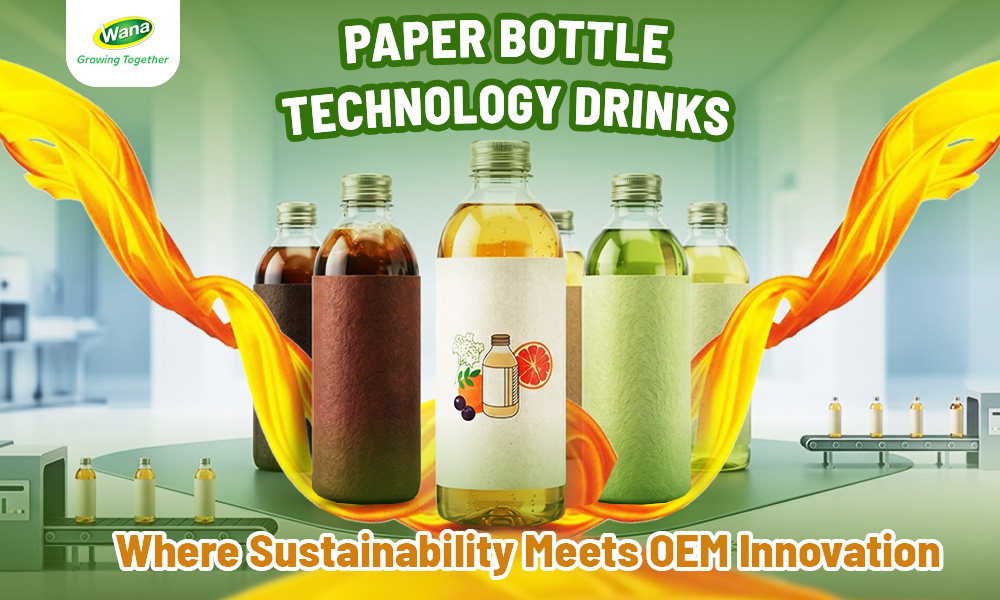
Paper bottles are beverage containers that use a paper- or fiber-based outer structure together with barrier materials that help protect the beverage from moisture, oxygen, and other external factors.
A typical structure includes:
- Outer shell: made from molded fiber or pressed paper
- Inner lining: acts as a barrier to protect product quality
- Closure system: designed to meet the product’s sealing and filling requirements
Unlike traditional plastic bottles, paper bottles do not just change the material — they change how consumers perceive the product, shifting from “packaging” to “experience.”
Why Is Paper Bottle Packaging Gaining Attention?
Packaging becomes a point of differentiation
In a saturated beverage market, products can easily feel similar in taste. Packaging then becomes the first touchpoint to capture consumer attention.
Paper bottles allow brands to create a distinct identity through storytelling, deliver a new kind of experience, and most importantly, help brands communicate a sustainability-focused positioning.
That sense of participation is what keeps customers engaged and connected to a brand in the long term.
Increasing pressure to innovate
Consumers, retailers, and distributors are paying increasing attention to packaging sustainability alongside product quality and formulation.
This pushes brands to:
🔹Innovate faster
🔹Be more flexible in product development
🔹Seek long-term packaging solutions
The shift toward flexible production models
OEM and private label manufacturing are becoming strategic choices for brands looking to launch products quickly.
Paper bottle solutions may give brands opportunities to:
- Explore differentiated packaging concepts
- Test new product positioning
- Develop packaging formats for specific target markets
Read more: rPET Beverage Bottles: A Sustainable Packaging Option for Brands
Benefits of Paper Bottles for Beverage Brands
Accelerating product launches
Instead of building production systems from scratch, brands can collaborate with OEM partners to quickly roll out paper bottle technology drinks.
Working with an experienced OEM partner can help brands reduce the need for direct investment in manufacturing infrastructure and access technical support during product development.
Expanding branding possibilities
Paper-based outer surfaces can provide distinctive design and branding opportunities, particularly for brands looking to create a natural or sustainability-focused visual identity.
Brands can:
🔹Print directly onto the paper surface
🔹Create limited-edition designs
🔹Leverage natural textures for a premium feel
These features work particularly well for “clean”, “organic”, and “functional” product concepts.
For brands developing new trends — such as functional beverages or lifestyle-driven products — or targeting export markets, this is a solution worth considering.
Enhancing perceived product value
If you were holding two coconut drinks — one in plastic packaging and one in a paper bottle — which one would you prefer?
Packaging can influence how consumers perceive a product’s quality, positioning, and sustainability. A distinctive paper-based format may therefore support premium positioning when it aligns with the overall product concept. And at the same time, the packaging may support a brand’s efforts to reduce reliance on conventional plastic materials, depending on its overall material composition and end-of-life pathway.
That’s the power of packaging.
Packaging does not just protect the product — it directly influences perceived value. A distinctive paper-based package can support premium positioning when combined with appropriate product quality, branding, and market strategy.
Supporting long-term growth strategies
For OEM and private label businesses looking to expand their service portfolio, attract international clients, and strengthen competitiveness, investing in paper bottle technology is a strategic move.
Paper bottle technology is one of several emerging packaging approaches that could play a role in the future of sustainable beverage packaging.
Challenges of Paper Bottle Packaging
Technical requirements
Despite its potential, paper bottle technology is still evolving and comes with technical challenges.
Unlike plastic, paper cannot naturally contain liquids. It requires multiple material layers to ensure moisture resistance, oxygen barrier, and product stability.
In addition, the packaging must meet requirements for:
🔹Mechanical strength
🔹Compatibility with filling lines
🔹Shelf life performance
This makes paper bottle development not just a material challenge, but a combination of technology, design, and manufacturing processes.
Production cost
Another challenge is cost.
Currently, large-scale production is still limited, and the technology is not yet widely adopted. As a result, costs remain significantly higher than plastic.
Brands with limited budgets may consider using paper bottles selectively — for specific product lines or campaigns — or explore alternative solutions that better match their current resources.
Recycling infrastructure
In many waste management systems today, sorting processes are designed for single-material streams such as plastic, paper, or metal.
Paper bottles, however, are composite materials — combining paper with an inner lining — which makes sorting more complex and prone to misclassification.
Additionally, not all markets have the infrastructure to process such materials effectively. Recycling and collection capabilities vary significantly by country and packaging format. Brands should therefore evaluate the end-of-life infrastructure available in each target market before making environmental or recyclability claims.
This highlights that beyond material innovation, brands must also focus on designing packaging that is easier to sort and clearly communicating disposal instructions to consumers.
Barrier Performance and Shelf Life
Because paper-based structures cannot independently provide the same liquid and gas barrier properties required for many beverages, additional barrier layers or coatings may be necessary. Brands should evaluate oxygen and moisture protection, product stability, filling conditions, and shelf life before selecting a paper bottle format.
Read more: Beverage Carton Sustainability: Benefits, Challenges, and Opportunities for Businesses
Applications of Paper Bottles in the Beverage Industry
Paper bottles can help create a distinctive product experience and support sustainability-focused positioning across selected beverage categories, including juices, functional beverages formulated with ingredients such as prebiotics, collagen, or sea moss.
They may be particularly relevant for premium and sustainability-focused product concepts, depending on packaging requirements and the regulations and waste-management infrastructure of the target market.
For OEM and private label businesses, paper bottles can also be explored for selected product launches, limited editions, or market tests where distinctive packaging is part of the product concept.
Beyond functionality, some brands leverage paper bottles not just to deliver products, but to communicate their sustainability commitments, position themselves as innovative players, and attract potential partners or investors. In this context, paper bottles go beyond traditional packaging and become part of a brand’s broader packaging and sustainability communication strategy.
The Future of Paper Bottle Technology Drinks
In the coming years, paper bottle technology is expected to continue evolving toward reducing the amount of plastic used in inner linings, improving overall recyclability, and optimizing production costs to better support large-scale commercialization.
As material innovation and manufacturing processes become more advanced, these improvements will help address current limitations and make paper bottles more accessible for a wider range of beverage categories.
At the same time, as more global brands begin to pilot and scale this packaging solution, paper bottle technology drinks are likely to move beyond niche applications and become an integral part of the broader beverage packaging ecosystem
Paper-Based Does Not Automatically Mean More Sustainable
The environmental performance of a paper bottle depends on more than its outer material. Brands should consider the full packaging structure, barrier materials, manufacturing process, transportation, product shelf life, collection systems, and end-of-life options before making sustainability claims.
Paper Bottles vs PET vs rPET: Which Is Right for Beverage Brands?
| Factor | Paper Bottle | PET | rPET |
|---|---|---|---|
| Main structure | Fiber/paper + barrier system | Plastic | Recycled PET |
| Weight | Depends on design | Lightweight | Lightweight |
| Liquid barrier | Requires barrier layer | Strong | Strong, application-dependent |
| Recyclability | Depends on structure & local system | Widely established | Established in many markets |
| Recycled content | Depends on design | Usually limited | High potential |
| Compostability | Product-specific | No | No |
| Cost | Generally higher | Generally competitive | Varies |
| Best suited for | Selected sustainability-focused concepts | Broad beverage applications | Brands seeking recycled content |
What Should Beverage Brands Consider Before Choosing Paper Bottles?
Choosing paper bottles for a beverage requires more than evaluating the appearance or sustainability benefits of the packaging. Brands should consider the following factors to ensure the packaging works for the product, production process, and target market:
- Beverage formulation: Consider the product’s acidity, ingredients, and overall composition to determine whether the packaging can maintain product quality throughout its shelf life.
- Filling process: The bottle must be compatible with the required filling temperature, sealing method, and production conditions.
- Shelf life: Evaluate whether the packaging can provide sufficient protection throughout the intended shelf life, especially for beverages sensitive to oxygen, moisture, or light.
- Barrier requirements: Paper-based structures typically require additional barrier layers or liners to protect the beverage from moisture, oxygen, and other external factors.
- Bottle strength: The packaging should provide adequate structural strength for filling, transportation, storage, and retail handling.
- Packaging cost: Compare material, production, tooling, transportation, and other packaging costs with alternatives such as PET, rPET, or aluminum.
- MOQ and scalability: Check whether the supplier can meet your initial order volume and scale production as demand grows.
- Target-market regulations: Review food-contact, labeling, packaging, and environmental requirements in each target market before making packaging claims.
- Recycling and collection infrastructure: Understand how the specific paper bottle structure is collected, sorted, and processed in the markets where the product will be sold.
- Environmental claims: Avoid broad claims such as “100% sustainable” or “fully biodegradable” unless they are supported by the product’s material composition, certifications, and applicable disposal conditions.
- OEM manufacturing capability: Work with an experienced beverage manufacturer that can evaluate packaging compatibility, support product development, and coordinate testing and commercial production.
WANA Beverage – OEM/ODM Beverage Manufacturing
For beverage brands exploring new packaging concepts, choosing the right manufacturing partner is essential to balance product quality, packaging performance, cost, and market requirements.
WANA Beverage provides OEM, ODM, and private label beverage solutions, supporting brands from formulation and product development to packaging, manufacturing, quality control, and export. The team works with different beverage categories and packaging formats based on each product’s specifications and target market.
When evaluating sustainable packaging options, WANA can help brands consider factors such as beverage compatibility, filling requirements, shelf life, packaging performance, and target-market needs before moving toward commercial production.
Frequently Asked Questions
What are paper bottles made of?
Paper bottles typically use a paper- or fiber-based outer structure combined with barrier materials that help protect the beverage.
Are paper bottles recyclable?
Recyclability depends on the bottle’s material structure and the collection and recycling infrastructure available in the target market.
Are paper bottles suitable for all beverages?
No. Suitability depends on factors such as beverage formulation, filling conditions, shelf life, and required barrier performance.
Are paper bottles more sustainable than plastic bottles?
Not necessarily in every application. Environmental performance depends on the full packaging structure, material sourcing, production, transportation, and end-of-life pathway.
Can beverage brands use paper bottles for OEM products?
Potentially, depending on the packaging format, beverage requirements, production capabilities, MOQ, and target-market regulations.
Conclusion
Paper bottle technology is an emerging approach to beverage packaging that offers new possibilities for brands seeking distinctive and sustainability-focused packaging formats. However, its suitability depends on factors such as beverage compatibility, barrier performance, shelf life, production cost, and end-of-life infrastructure.
For beverage brands, the goal should not simply be to replace plastic with paper, but to choose a packaging solution that balances product protection, commercial requirements, sustainability goals, and target-market expectations.
Working with an experienced OEM beverage manufacturer can help brands evaluate these factors and develop packaging solutions that are practical for commercial production.