Choosing the right white label drink supplier requires more than comparing prices. Beverage brands should evaluate product quality, food safety certifications, MOQ, production capacity, packaging options, lead times, and export capabilities. A reliable white label beverage supplier should provide clear specifications, consistent quality control, and responsive communication. The right manufacturer should support both your current launch and future growth.
What Is a White Label Drink Supplier?
A white label drink supplier is a beverage supplier or contract manufacturer that produces beverages you can sell under your own brand. Depending on the manufacturing partner, you may choose from pre-developed formulas, request limited adjustments, or develop a more customized product (often closer to private label). The right fit depends on your target market, packaging format, compliance needs, and the volumes you can commit to.
What Are White Label Beverages?
White label beverages are ready-developed drinks manufactured by one company and sold by another business under its own brand. In most cases, the base formula already exists, and you adapt branding elements such as label design, carton artwork, and sometimes flavors or sweetness. Many beverage manufacturers also offer multiple packaging formats (for example, cans or bottles) and standard specifications to help brands move faster. Always confirm what is truly “white label” versus what requires custom R&D, custom ingredients, or custom packaging procurement.
White Label vs. Private Label Beverages
These terms are used differently across beverage suppliers and private label beverage manufacturers, so confirm definitions during sourcing.
| Factor | White Label | Private Label |
|---|---|---|
| Formula | Usually existing formula | Existing or customized formula |
| Customization | Limited to moderate | Moderate to extensive |
| Development time | Usually faster | Depends on customization |
| MOQ | Often lower | Can be higher |
| Branding | Buyer’s brand | Buyer’s brand |
| Best for | Faster market entry | Greater product differentiation |
In the beverage industry, white label and private label are sometimes used interchangeably. Always confirm the supplier’s definition, customization scope, MOQ, and development process.
Benefits of White Label Beverages for Brands
- Faster market entry
- Lower product development costs
- Reduced R&D requirements
- Lower initial risk
- Access to established manufacturing capabilities
- Easier product line expansion
What to Look for in a White Label Drink Supplier
This is typically the most important part of supplier selection. Use the criteria below to compare a white label beverage supplier, beverage manufacturer, or contract manufacturer based on operational fit—not just a quotation.
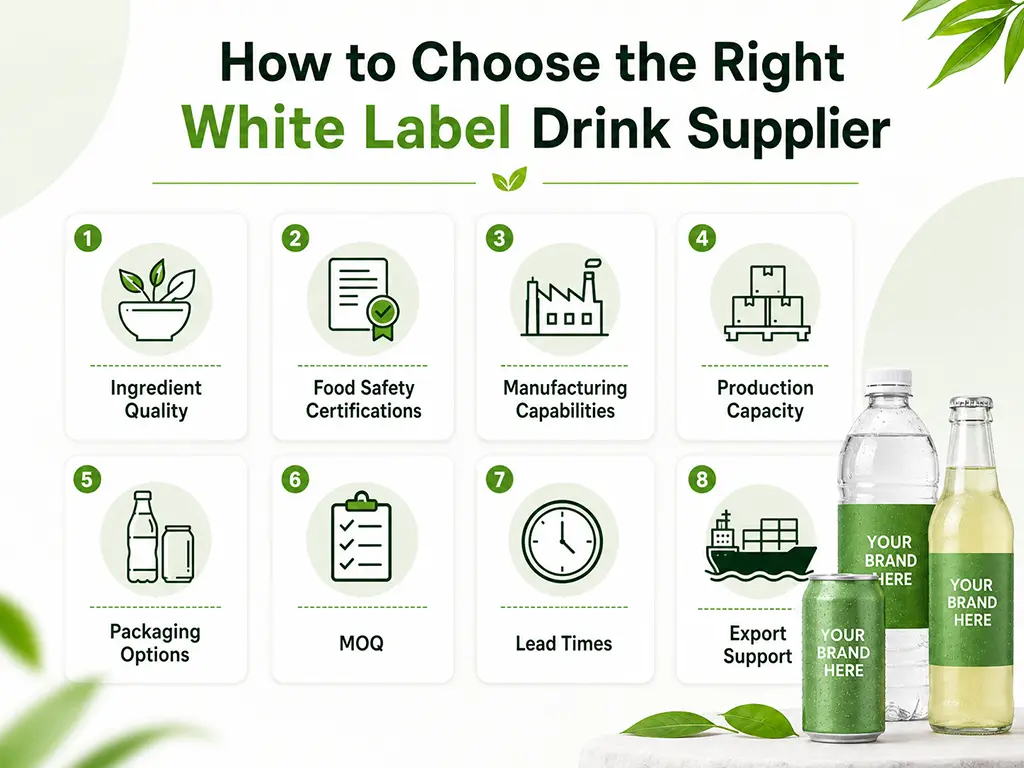
Ingredient Quality
Ask how ingredients are sourced and controlled (supplier approval, specifications, allergen management, and traceability). Request the documentation you need as an importer or brand owner. This may include ingredient lists, allergen statements, and certificates of analysis (COAs). Also ask how the supplier measures batch-to-batch consistency.
Food Safety Certifications
Certifications matter because they reduce risk and often make retailer approval, third-party audits, and international sourcing easier. Ask which systems your manufacturing partner holds and what the scope covers (site, processes, and product categories). Common examples include HACCP, ISO 22000, FSSC 22000, BRCGS, and Halal. Don’t just collect logos—confirm why they matter for your route-to-market (for example, certain retailers or distributors may prefer BRCGS/FSSC-aligned facilities, and exporters may need audit-ready documentation and traceability).
Manufacturing Capabilities
Capabilities describe what the beverage manufacturer can produce: beverage types (carbonated vs. still), processing methods (hot fill, aseptic, pasteurization), functional blending, and filling lines (cans, PET, glass, cartons, pouches). Ask what they manufacture regularly (not just what they “can do”) and whether the capability is in-house or subcontracted.
Production Capacity
Capacity is how much the factory can produce within a given time. Confirm realistic output for your format and seasonality, how production slots are allocated, and whether they can support growth across multiple SKUs. A great beverage supplier for a pilot run may not be the best manufacturing partner once you scale.
Product Customization
Clarify what can be customized without full R&D: sweetness, flavor profiles, functional ingredients, colors, carbonation level, caffeine content, and nutritional targets. Ask whether changes trigger new stability work, labeling updates, or higher MOQs. If you need differentiation, confirm whether you’re working with a true private label beverage manufacturer model (custom spec) or a limited-variation white label program.
Packaging Options
Ask which formats and sizes are available and what is stock vs. custom: aluminum cans, PET bottles, glass bottles, different fill sizes, cartons, and secondary packaging (cartons, trays, shrink wrap). Packaging choices can affect unit economics, minimums, shelf appeal, shipping efficiency, and breakage risk.
Minimum Order Quantity (MOQ)
MOQ is often the biggest commercial constraint. MOQ can vary based on formula, packaging format, printing requirements, and production setup. Confirm MOQ per SKU, MOQ per packaging component (for example, printed cans/labels/cartons), and whether mixed flavors share the same MOQ threshold. Also ask about trial runs or stock packaging options that may reduce initial commitments.
Sample and Production Lead Times
Use more specific timelines than a single “lead time.” Separate:
- Sample lead time: from brief to sample delivery (including revisions).
- Mass production lead time: from approved sample + packaging artwork to finished goods ready to ship.
Ask what typically causes delays (packaging procurement, ingredient approvals, production scheduling, testing) and build buffer into your launch plan.
Regulatory and Export Compliance
If you’re importing or selling across markets, compliance support is a core capability. Confirm the supplier can provide (as applicable): ingredient documentation, COA, product specifications, labeling support, health certificates, Certificate of Origin, and other export documents. Clarify who is responsible for final label compliance in your destination market and what documentation is available for customs clearance and distributor onboarding.
What Types of White Label Beverages Are Available?
Product availability depends on the beverage manufacturer’s equipment, processing methods, and sourcing. Many white label beverage suppliers offer multiple categories that can be branded as separate SKUs.
Carbonated Drinks
Flavored sodas and sparkling beverages with defined carbonation and shelf-life requirements.
Juice Drinks
Juice blends, nectars, and juice-based drinks that may require specific pasteurization and stability controls.
Coconut Water
Often positioned for hydration; confirm origin, taste profile, and quality consistency across batches.
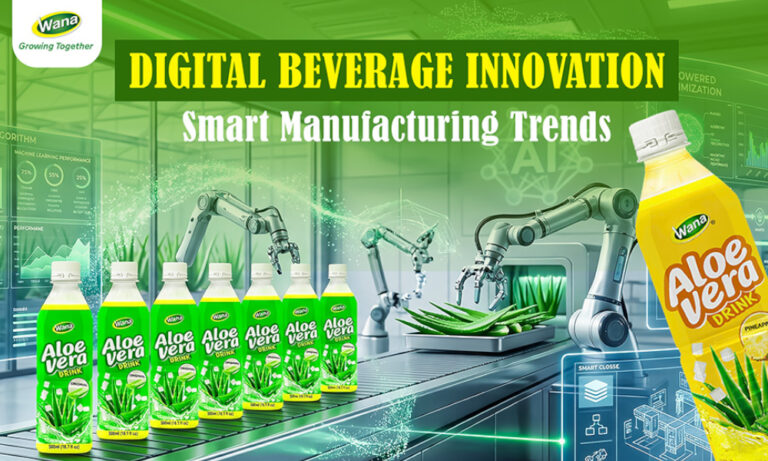
Aloe Vera Drinks
Frequently include aloe pieces; confirm texture targets and suspension/stability performance over shelf life.
Energy Drinks
Typically caffeinated; confirm caffeine limits, labeling requirements, and target-market compliance.
Functional Beverages
Vitamins, minerals, collagen, probiotics, or other functional ingredients. Ensure claims and labeling are appropriate for your market.
Tea Drinks
Ready-to-drink teas, flavored teas, or tea-based functional beverages.
Coffee Drinks
RTD coffee and coffee-based drinks; confirm dairy/plant-based handling and shelf-life expectations.
How to Evaluate a White Label Beverage Supplier
Use a consistent evaluation method so you can compare beverage suppliers and contract manufacturers on the same criteria.
Request Product Samples
Request samples that match your target positioning (taste, sweetness, mouthfeel, and packaging format if available). Ask whether the sample is lab-scale or production-representative and what variation is considered normal in mass production.
Review Product Specifications
Request product specs, ingredient statements, allergen info, nutrition targets, shelf life, storage conditions, and any available testing or stability data. This helps you avoid surprises after sampling.
Compare MOQ, Pricing, and Total Costs
Assess total landed and launch costs, not just unit price: unit cost, MOQ, packaging and printing, tooling/artwork setup, freight, documentation, sample costs, and payment terms. Ask for assumptions so you can compare like-for-like.
Assess Production Capacity
Confirm whether capacity supports your launch timeline and repeat orders. Ask about peak-season constraints and how production slots are reserved.
Verify Certifications
Request current certificates and verify scope (site, processes, product categories). If a retailer or distributor requires specific standards, confirm that before you finalize a manufacturing partner.
Review Export Experience
Ask which markets they ship to today and what export documentation they routinely provide. Export experience can reduce delays in customs clearance and importer onboarding.
Evaluate Communication and Response Time
Strong communication is an operational advantage. Look for clear next steps, written confirmations, realistic timelines, and transparent answers about limitations.
Questions to Ask Before Choosing a Supplier
Use these questions to run consistent due diligence across suppliers. Each includes what to listen for in the answer.
What is your minimum order quantity?
MOQ depends on the beverage type, packaging format, formula, and printing requirements. Confirm both the MOQ per SKU and the minimum quantity required for custom packaging before requesting a quotation.
What food safety certifications does your facility hold?
Ask for current certificates and confirm scope (which factory site, which processes, and which product categories). If you sell to retailers or distributors with audit requirements, confirm whether the certification is commonly accepted for your channel.
Can you customize the formula?
Clarify what customization is possible (sweetness, flavors, functional ingredients, caffeine, colors, carbonation) and what triggers R&D fees, new stability testing, or higher MOQs.
Which packaging formats and sizes are available?
Confirm available formats (cans, PET, glass, cartons) and whether packaging components are stock or custom. Ask about minimums for printed components and typical procurement timelines.
How long does sample development take?
Ask for a typical range and what inputs they need (brief, target profile, packaging format). Confirm how many revisions are included and whether sample costs are credited to a first order.
What is your typical production lead time?
Separate sample lead time from mass production lead time. Ask what commonly causes delays (packaging procurement, ingredients, scheduling, testing) and how timelines change for repeat orders.
Can you support labeling and export documentation?
Confirm what they provide (COA, product specs, ingredient documentation, health certificates, Certificate of Origin, shipping documents) and what the importer must handle locally (for example, final label compliance review).
Which markets do you currently export to?
Markets served is a practical signal of export readiness. Ask what documentation and labeling adjustments are typically needed for those markets and whether they have experience with your target destination.
How do you manage quality control?
Look for defined incoming checks, in-process controls, finished goods testing, traceability, and clear procedures for deviations. Ask how batches are released and what documentation you receive per lot.
What happens if a batch does not meet specifications?
Ask about investigation, corrective actions, and options such as rework, replacement, or credit terms. A professional beverage manufacturer should have a clear nonconformance process.
What Affects White Label Beverage Pricing and MOQ?
White label beverage pricing and MOQ are driven by product, packaging, and operational constraints. Ask suppliers to explain assumptions so you can compare quotes fairly.
Ingredients
Ingredient quality, origin, and functional additives can change cost significantly, especially for specialized functional ingredients.
Packaging Format
Packaging choice (cans vs. bottles vs. cartons), closure types, and secondary packaging all influence cost and minimums.
Order Volume
Higher volume typically lowers unit cost, but only if the factory can schedule production efficiently for your SKU mix.
Formula Complexity
More complex formulations may require additional processing steps, testing, or specialized handling, which can raise both cost and lead time.
Certifications
Maintaining certain standards and audit programs can increase overhead; however, certifications may reduce market-entry friction and retailer risk.
Label and Carton Customization
Custom printing (labels, cartons, shrink sleeves, trays) often introduces packaging MOQs and longer procurement lead times.
Shipping Terms
Incoterms and freight method affect landed cost. Clarify what is included in the quote and what is paid separately.
Number of SKUs
Multiple SKUs can increase complexity for planning, packaging minimums, and line changeovers. For example, 5 SKUs × 1 container can price differently than 1 SKU × 5 containers.
How to Build a Successful Supplier Partnership
A strong partnership with your manufacturing partner reduces risk and improves consistency over time—especially when you add new flavors or expand to new markets.
Maintain Clear Communication
Define points of contact, response expectations, and written approval steps for formula, packaging, and schedule changes.
Define Product Specifications
Document sensory targets, ingredient constraints, allergens, nutrition targets, packaging format, labeling requirements, and acceptance criteria.
Agree on Production and Delivery Timelines
Set timelines for sampling, artwork approval, packaging procurement, production, and shipment—then build in buffer for revisions and logistics.
Establish Quality Control Standards
Align on testing, traceability, release documentation, and how deviations are handled. Confirm what records you receive per batch.
Review Performance and Improve Continuously
After each run, review defects, taste consistency, lead time accuracy, and communication. Use feedback to improve the next production cycle.
Why Choose Wana as a White Label Drink Supplier in Vietnam?
Wana supports OEM, ODM, and private label beverage production for international brands. Its current production network includes one main factory and four co-invested facilities in Southern Vietnam, with stated capacity of up to 600 containers per month.
Beverage Manufacturing Capabilities
List the beverage categories Wana currently manufactures (for example: coconut water, aloe vera drinks, juice drinks, energy drinks, functional beverages) and the formats/processes supported (for example: cans vs. bottles; hot fill vs. aseptic). Add representative product specs or ranges where possible.
Food Safety and Quality Standards
State the exact certifications held (for example, HACCP, ISO 22000, FSSC 22000, BRCGS, Halal—only if applicable) and include scope details (site/process) plus what documentation buyers receive per batch (COA, traceability records, specifications).
OEM, ODM, and White Label Options
Explain which models Wana supports and what changes are possible under each (stock formulas vs. customized specs). Clarify whether Wana operates as a private label beverage manufacturer for custom formulations and what minimums apply.
Packaging Capabilities
List available packaging formats and sizes, and clarify what is stock vs. custom printed (labels/cartons). Mention packaging MOQ considerations and typical packaging procurement timelines if you have them.
Export Support
Specify what export documents Wana provides (for example: Certificate of Origin, health certificates, COA, product specs, shipping documents) and which markets Wana regularly exports to. This is especially valuable for importer intent.
Sample Development and Production Process
Outline the step-by-step process (brief → sampling → approvals → packaging → mass production → shipment). If you have real timelines (sample lead time and mass production lead time), include ranges by category or format.
How to Choose the Right White Label Drink Supplier
The right white label drink supplier should offer more than competitive pricing. Beverage brands should compare product quality, certifications, MOQ, manufacturing capacity, customization options, lead times, quality control, and export support. Choose a beverage supplier or contract manufacturer that can meet your current requirements while also supporting future product and market expansion.
Wana Beverage supports OEM, ODM, and private label projects from product development and packaging to manufacturing and export preparation. Contact our team to discuss your target market, product category, packaging format, and expected order volume.