
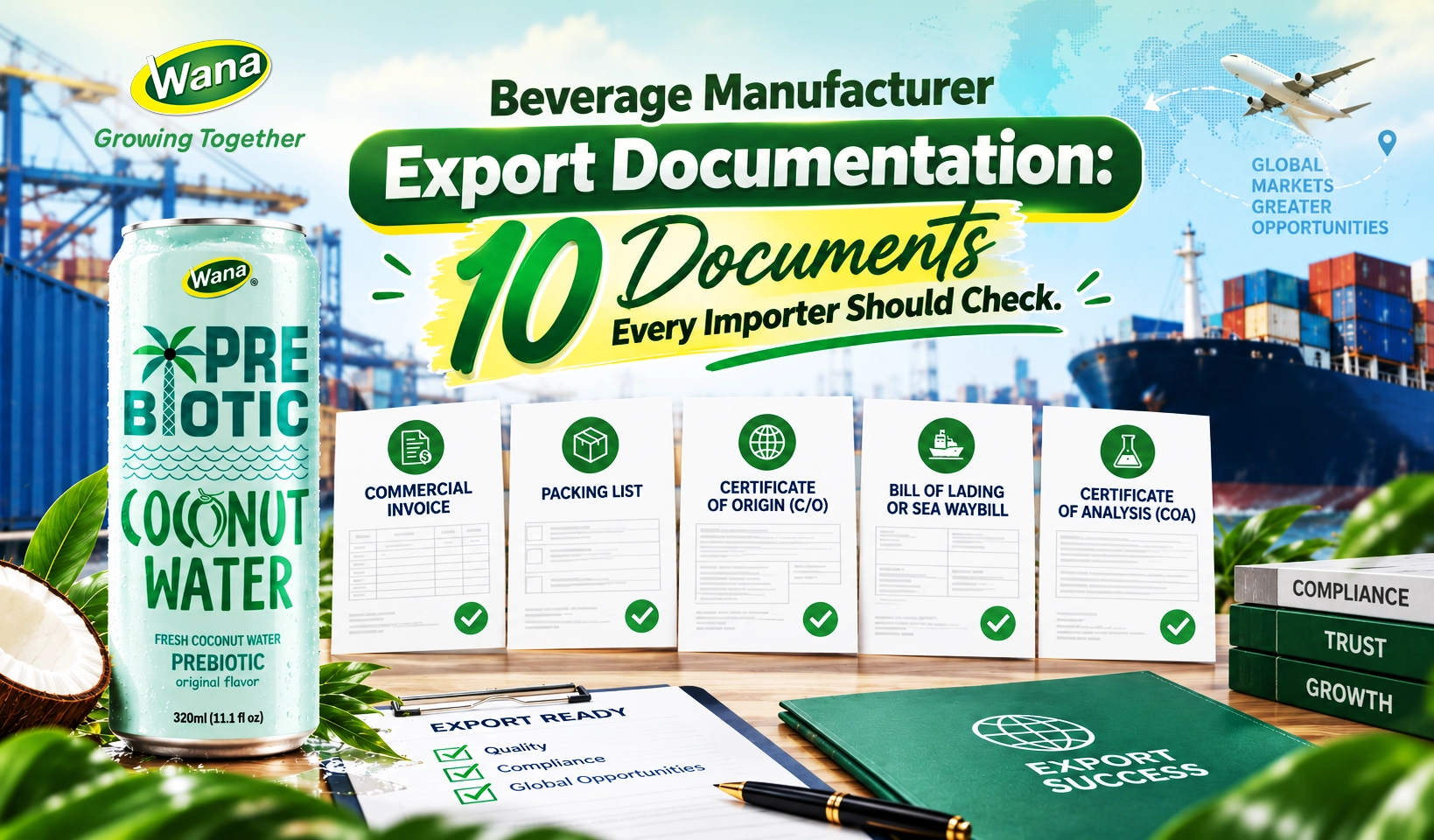
A beverage shipment can be ready for export, but one missing or incorrect document can delay customs clearance, increase costs, or even hold the shipment at the port.
For importers and distributors, choosing a beverage manufacturer should involve more than comparing price, MOQ, and production time. The manufacturer’s ability to prepare accurate and complete export documentation is equally important for ensuring a smooth international shipment.
In this guide, we’ll cover 10 essential export documents every beverage importer should check before working with a manufacturer.
Not every item on this list is a mandatory customs document. Some support customs clearance, while others help verify product compliance, product origin, or supplier capability. Requirements vary by destination market, product type, and shipment.
Why Export Documentation Matters for Beverage Importers
For beverage importers, export documentation is more than administrative paperwork. Accurate and complete documents are essential for customs clearance, regulatory compliance, shipment coordination, and smooth delivery.
Avoid Customs Delays
Missing, inaccurate, or inconsistent documents can delay customs clearance and potentially result in additional storage, inspection, or handling costs. Importers should ensure that key shipment information is complete and consistent across all documents.
Verify Product Compliance
Importers may need to provide product information to demonstrate that the beverage meets the regulatory requirements of the destination market. Documents such as product specifications, ingredient lists, Certificates of Analysis, and food safety documentation can help support this process.
Support Tariff and Country-of-Origin Claims
A Certificate of Origin may be required to verify where the beverage was manufactured. This can be particularly important when an importer is seeking preferential tariff treatment under a free trade agreement.
Reduce Import Risks
Reviewing documentation before shipment allows buyers to identify potential issues with product specifications, ingredients, HS codes, quantities, or country-of-origin information before the goods leave the factory.
Keep the Supply Chain Moving
Export documentation often involves several parties, including the manufacturer, freight forwarder, customs broker, and importer. Clear and consistent paperwork helps these parties coordinate more efficiently and reduces the risk of unnecessary delays during international transportation and customs clearance.
The goal is not simply to collect documents. It is to make sure the right information is accurate, consistent, and available when needed.
10 Export Documents Every Beverage Importer Should Check
Before production starts, importers should confirm which documents their manufacturer can provide and which documents are required in the destination market.
The exact requirements vary by country, beverage category, ingredients, HS classification, and applicable regulations.
Commercial Invoice
The Commercial Invoice contains the main commercial details of the shipment and is commonly used for customs valuation and clearance.
Key information includes:
- Seller and buyer details
- Product description
- Quantity
- Unit price and total value
- Currency
- Incoterms or agreed trade terms
The information should match the purchase order and other relevant shipping documents.
Packing List
The Packing List shows how the goods are packed and helps the importer, carrier, and customs authorities verify the shipment.
It may include:
- Number of cartons or cases
- Product quantities
- Net and gross weight
- Carton dimensions
- Number of pallets
The quantities and packing details should be consistent with the actual shipment.
Certificate of Origin (C/O)
A Certificate of Origin (C/O) provides evidence of the product’s country of origin. It may also be required when an importer wants to claim preferential tariff treatment under an applicable trade agreement.
The specific C/O requirements depend on the destination market and the relevant trade agreement.
Bill of Lading or Sea Waybill
The Bill of Lading or Sea Waybill contains key transportation details for an ocean shipment.
It typically identifies the:
- Shipper
- Consignee
- Port of loading
- Port of discharge
- Vessel and voyage
- Cargo and package information
Importers should check that these details are consistent with the Commercial Invoice and Packing List.
Certificate of Analysis (COA)
A Certificate of Analysis provides test results for a specific production batch and helps verify whether the finished beverage meets the agreed specifications.
Depending on the product and market, it may include microbiological, chemical, or other quality parameters, along with the relevant batch or lot number.
Product Specification Sheet
The Product Specification Sheet provides key information about the finished beverage and can support product registration, regulatory review, and quality control.
It may include:
- Product description
- Ingredients or composition
- Nutrition information
- Shelf life
- Storage conditions
- Packaging format and size
Importers should make sure the specification reflects the final commercial product.
Ingredient List and Formula Information
Accurate ingredient information is important for product registration and label compliance.
Importers may need to review information about:
- Allergens
- Food additives
- Sweeteners
- Functional ingredients
- Fruit or juice content
- Flavoring ingredients
The final ingredient information should match the product actually manufactured.
Health, Food Safety, or Free Sale Documentation
Some markets require additional documents to demonstrate that imported beverages meet local food safety or market-entry requirements.
Depending on the product and destination, these may include:
- Health Certificate
- Certificate of Free Sale
- Food Safety Certificate
- Sanitary or other regulatory documents
Importers should confirm the exact requirements with the relevant local authorities or customs and regulatory professionals.
Manufacturer Certifications and Compliance Records
Factory certifications and compliance records can help importers evaluate the manufacturer’s food safety and quality management systems.
Depending on the facility, these may include:
- BRCGS
- FSSC 22000
- HACCP
- ISO 22000
- GMP
- HALAL
- FDA Registration
These credentials are not necessarily customs documents, but they can be important when evaluating a supplier, particularly for retail programs and regulated markets.
Read more: How to Choose a Beverage Manufacturer with ISO 22000 Certification
HS Code & Product Classification
The HS Code (Harmonized System Code) is used to classify products for international trade. It can affect import duties, taxes, customs procedures, and tariff eligibility.
Importers should confirm the appropriate classification based on the beverage type, ingredients, and product composition before shipment.
The manufacturer can provide product information to support classification, while the importer or customs broker should verify the final HS Code with the destination country’s customs authority.
Which Documents Are Most Important for Customs Clearance?
Not all documents serve the same purpose. Some are primarily used for customs and shipping, while others support product compliance or supplier verification.
Commonly Relevant to Customs and Shipping
These documents are commonly involved in international shipment processing:
- Commercial Invoice
- Packing List
- Bill of Lading or Sea Waybill
- Certificate of Origin, where applicable
- Customs Declaration
The exact requirements depend on the destination country, product, and shipment.
Important for Product Compliance
Other information may be required to demonstrate that the beverage meets local regulations:
- Certificate of Analysis
- Product Specification Sheet
- Ingredient Information
- Health or Food Safety Documentation
- Certificate of Free Sale, where applicable
Important for Supplier Evaluation
Certifications and quality records help buyers evaluate the manufacturer’s production and food safety systems.
For importers, the key is to understand which documents are required for customs, which support regulatory compliance, and which help assess the supplier.
What Should Importers Confirm Before Production?
Documentation should be discussed before production begins, not when the shipment is already at the port.
Importers should confirm:
- HS Code – Verify the product classification.
- Product Description – Keep the product name and description consistent.
- Country of Origin – Confirm where the beverage is manufactured.
- Ingredients – Check that the formulation meets destination-market requirements.
- Label Requirements – Confirm required information for the final market.
- Shelf Life – Check any minimum shelf-life requirements.
- Required Certificates – Confirm which certificates or regulatory documents are needed.
- C/O Eligibility – If preferential tariffs may apply, check the relevant origin requirements.
- Import Registration – Confirm whether the product or importer needs prior registration.
Confirming these requirements early gives both the importer and manufacturer time to resolve potential issues before production and shipment.
Common Export Documentation Mistakes Importers Should Avoid
Documentation problems are often preventable. The most common mistakes include:
Asking for Documents Too Late
Discuss documentation requirements before production rather than waiting until the shipment is ready.
Not Checking Destination-Market Requirements
Import requirements differ between countries. Do not assume that the same documents apply to every market.
Using an Incorrect Product Description
The product description should accurately reflect the beverage and remain consistent across relevant documents.
Mismatched Information
Differences in product names, quantities, weights, carton numbers, or other details can create unnecessary questions during customs clearance.
Not Confirming the HS Code
An incorrect classification can affect duties, taxes, and import requirements. Confirm the HS Code before shipment.
Ignoring Certificate of Origin Requirements
If preferential tariff treatment is important, confirm the applicable origin and C/O requirements before production.
Using Outdated Product Information
Make sure documents reflect the final commercial formula, packaging, specifications, and labeling rather than an earlier sample.
A simple document checklist shared between the importer and manufacturer can prevent many avoidable problems.
How to Choose a Beverage Manufacturer with Reliable Export Documentation
Choosing the right beverage manufacturer is not only about production capacity, MOQ, or price. For importers and distributors, the manufacturer’s ability to manage export documentation can directly affect shipment efficiency and customs clearance.
Here are several factors buyers should evaluate:
Export Experience
Ask where the manufacturer has previously exported products. Experience with international shipments can indicate whether the manufacturer understands different market requirements and shipping procedures.
Documentation Capability
Check whether the manufacturer has an export or documentation team that can prepare and provide the required paperwork accurately and on time.
Product Traceability
A reliable manufacturer should have clear batch records, production records, and quality documentation. This makes it easier to trace a product if questions arise after shipment.
Regulatory Knowledge
The manufacturer should understand the basic documentation and compliance requirements associated with the destination market and product category.
Communication
Export documentation often involves multiple parties. Fast and accurate communication between the manufacturer, importer, freight forwarder, and customs broker can help prevent unnecessary delays.
Production and Documentation Consistency
Product information should remain consistent across the actual goods and all relevant documents, including product name, quantity, packaging, batch information, and specifications.
A manufacturer that can produce the beverage and manage the documentation properly gives importers greater confidence throughout the international supply chain.
Read more: How to Create Your Own Drink Brand Without Building a Factory
WANA Beverage: Supporting Global Buyers with Export-Ready Documentation
WANA Beverage works with importers, distributors, and beverage brands through OEM, ODM, and private label manufacturing.
Our support covers product development, specifications, ingredient information, quality documentation, production, and export-related paperwork. WANA’s manufacturing and quality systems include certifications and registrations such as FSSC 22000, BRCGS, HACCP, ISO 22000, GMP, HALAL, and FDA Registration.
For international buyers, accurate documentation needs to match the finished product. WANA supports product traceability and provides the information needed for customers to coordinate with freight forwarders, customs brokers, and regulatory teams.
From fruit juice and coconut water to sparkling beverages, energy drinks, functional beverages, tea, and other ready-to-drink products, WANA provides manufacturing support from product development through international shipment.
FAQ
What documents should I request from a beverage manufacturer before placing an order?
Common documents and information include the Commercial Invoice, Packing List, Certificate of Origin, Bill of Lading, COA, Product Specification Sheet, ingredient information, and any destination-specific regulatory documents.
What is the most important document for beverage importers?
There is no single document that is most important for every shipment. The required documents depend on the destination market, product, HS classification, and import regulations.
Do beverage imports require a Certificate of Origin?
Not always. A Certificate of Origin may be required by the destination market or used to support preferential tariff treatment under an applicable trade agreement.
What is a COA for beverages?
A Certificate of Analysis provides test results for a specific production batch and helps verify that the beverage meets the agreed quality specifications.
Does every country require the same beverage import documents?
No. Import requirements vary by country, product category, ingredients, packaging, and applicable regulations. Importers should confirm the requirements for their specific market before shipment.
Can a beverage manufacturer help with export documentation?
Yes. An experienced manufacturer can typically provide or support product, quality, origin, and shipment documents. Importers should also confirm destination-specific requirements with their customs broker or relevant regulatory authority.
Conclusion
Export documentation is an important part of international beverage sourcing. For importers and distributors, checking the required documents before production and shipment can help reduce customs delays, compliance issues, and unexpected costs.
The best approach is to confirm the right documents, product information, HS classification, origin requirements, and destination-market regulations before the goods leave the factory.
When evaluating a beverage manufacturer, look beyond price and MOQ. A supplier with reliable documentation, quality systems, export experience, and clear communication can make international sourcing significantly easier.