Navigating beverage supply chains for the United States market requires balancing landed costs, strict FDA compliance, and speed-to-market. As US importers, brand owners, and distributors actively diversify sourcing away from traditional manufacturing hubs, choosing a qualified Vietnam beverage supplier for United States importers has become a central strategy for scaling high-margin SKUs. Vietnam offers an ideal combination of raw agricultural access, advanced cold-chain processing, and favorable trade positioning.
This guide from WANA Beverage provides a comprehensive operational breakdown for US buyers looking to launch or scale co-packing contracts and private label drinks for United States market distribution channels.
Key Takeaways for US Importers
-
China+1 Tariff Savings: Sourcing from Vietnam bypasses Section 301 tariffs, significantly lowering total landed costs to US ports.
-
CBP Origin Compliance: Meets US substantial transformation rules using 100% local raw ingredients and full domestic processing.
-
Turnkey FDA Clearance: Ensures smooth customs entry via active FCE registration and product-specific SID filings.
-
PDCAAS Label Alignment: Formulates collagen with complete proteins to legally claim
%DV Proteinon US retail panels. -
5 Trending Categories: Full OEM/ODM production for Protein Drinks, Coconut Water, Tropical Juices, Prebiotic Soda, and Clean Energy.
-
Proven Scale & Capacity: Backed by WANA’s 5 factories, 15+ high-speed lines, 15+ packaging options, and export footprint across 60+ countries.
The China+1 Economics: Calculating Section 301 Tariff Savings & Landed Cost to US Ports
For beverage brands importing into the United States, choosing a manufacturing location involves more than comparing factory prices. Import duties, trade policies, and international freight costs can significantly impact the final landed cost of a product.
This is where the China+1 sourcing strategy becomes increasingly relevant.
By diversifying production from China to alternative manufacturing destinations such as Vietnam, beverage brands can reduce exposure to China-specific tariffs, improve supply chain flexibility, and potentially achieve a more competitive total import cost.
Understanding the Tariff Advantage: China vs. Vietnam
Section 301 tariffs can significantly influence the total import cost of products entering the United States. Depending on the product’s HTSUS classification, country of origin, and applicable trade measures, imports from different manufacturing countries may be subject to different tariff rates.
For beverage importers, this makes accurate product classification and tariff verification essential before making sourcing decisions.
When evaluating China versus Vietnam, consider the following:
| Cost factor | China | Vietnam |
|---|---|---|
| Base custom duty | Depends on HTSUS classification | Depends on HTSUS classification |
| China-specific Section 301 tariffs | May apply, depending on product classification | Generally not subject to China-specific measures |
| Other applicable trade measures | Must be verified | Must be verified |
| International freight | Depends on shipping route and carrier | Depends on shipping route and carrier |
| Additional import charges | Applicable | Applicable |
Note: Tariff treatment is subject to change. Importers should verify the latest HTSUS classification, Chapter 99 provisions, applicable exclusions, and country-of-origin requirements with a qualified customs broker.
How to Calculate the Total Landed Cost
A lower manufacturing quotation does not necessarily translate into a lower total import cost.
To make an accurate comparison, importers consider all major cost components:
- Product manufacturing cost: The negotiated cost of producing the beverage, including ingredients, packaging, and production requirements.
- International freight: Ocean freight and other transportation-related expenses.
- Customs duties: Applicable base import duties and additional tariffs based on product classification and origin.
- Import processing fees: Charges such as Merchandise Processing Fees (MPF) and Harbor Maintenance Fees (HMF), where applicable.
- Other logistics expenses: Customs brokerage, port handling, insurance, inland transportation, and other destination-related charges.
The general calculation is:
Total Landed Cost = Product Cost + International Freight + Customs Duties + Import Fees + Other Logistics Expenses
This approach provides a more complete picture of sourcing costs and helps businesses evaluate manufacturing locations based on their actual import requirements.
Meeting US CBP Substantial Transformation Standards
To legally claim Vietnam origin (Country of Origin: Vietnam) and prevent transshipment penalties from US Customs and Border Protection (CBP), production must meet strict substantial transformation criteria:
- 100% Domestic Raw Ingredient Sourcing: Key agricultural inputs are harvested directly within Vietnam (e.g., NFC coconut water from Ben Tre, dragon fruit from Binh Thuan, calamansi from Tan Phu).
- Complete Technical Processing: Formulations undergo primary mixing, carbonation/filling, and full thermal sterilization or retort processing at certified Vietnamese production facilities (such as WANA’s Chau Duc plant).
- Primary Packaging Fabrication: Aluminum cans and PET bottles containers are shaped and filled domestically in Vietnam.
US FDA Regulatory Clearance: FCE/SID Filings & Labeling Compliance
Exporting beverages to the United States requires strict adherence to FDA regulations. Non-compliant shipments face automatic detention at ports of entry such as Long Beach, Newark, or Houston.
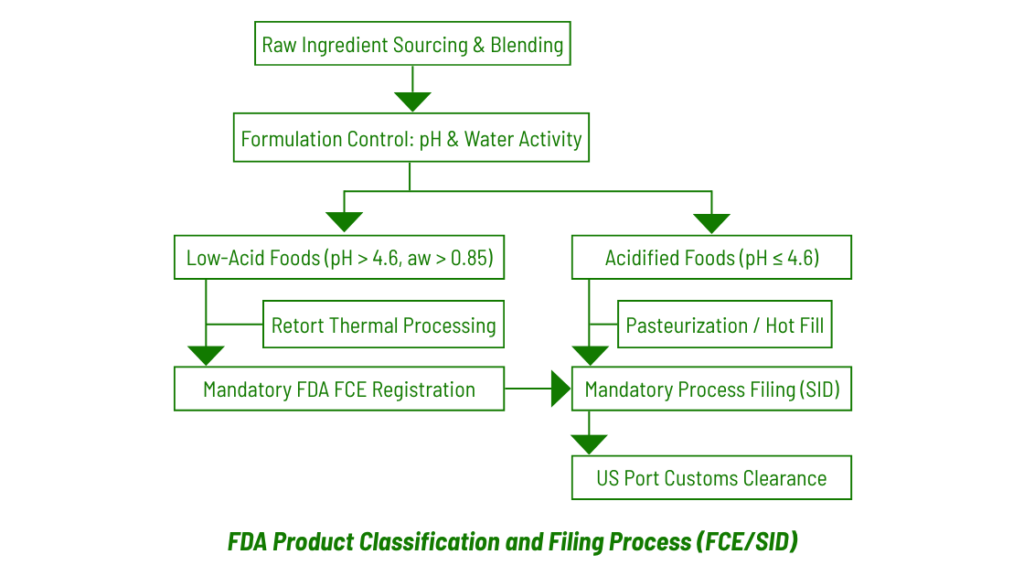
FCE & SID Registrations for Thermally Processed Drinks
- Food Canning Establishment (FCE): The overseas manufacturing facility must maintain an active FDA FCE registration.
- Submission Identifier (SID): Every specific low-acid (pH>4.6,aw>0.85) or acidified beverage (pH4.6) exported to the US requires an individual SID filing detailing thermal lethality times (F0 values), processing temperatures, and equilibrium pH controls.
FDA PDCAAS Rules for Protein Beverage Labeling
US importers formulating functional protein drinks must comply with FDA 21 CFR 101.9(c)(7):
- Collagen Limitation: Hydrolyzed collagen peptides have a Protein Digestibility-Corrected Amino Acid Score (PDCAAS) of 0.0. Under FDA rules, single-source collagen drinks cannot state a % Daily Value (%DV) for protein on the Nutrition Facts panel.
- Compliant Solution: To legally print %DV Protein on US retail packaging, formulations must blend collagen with complete proteins, such as Acidified Whey Protein Isolate (WPI) or balanced plant-based protein complexes.
Top 5 Trending Beverage Categories for Private Label Brands in the United States Market
To capture retail shelf space and maximize profit margins across US channels, from natural grocery stores like Whole Foods and Sprouts to mainstream giants like Target, Costco, and Amazon, importers and brand owners must align directly with evolving consumer health and lifestyle habits.
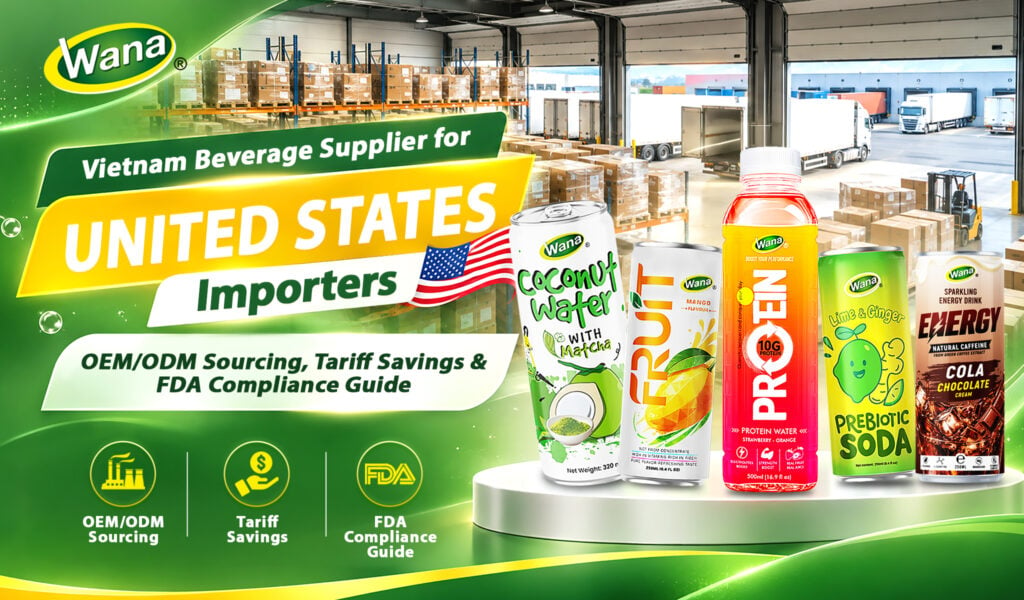
WANA Beverage provides complete, scalable OEM/ODM manufacturing solutions, equipping US private label brands to capitalize on all five of the fastest-growing drink categories in the American market today.
| 5 HIGH-GROWTH US BEVERAGE CATEGORIES | |
|---|---|
| Protein Drinks | Active lifestyle, gym culture and GLP-1 nutrition demand |
| Coconut Water | Clean-label, natural electrolyte hydration |
| Fruit Juice | Immunity-boosting exotic tropical flavors (low added sugar) |
| Carbonated Drinks | Soda, prebiotic gut health and guilt-free fizz |
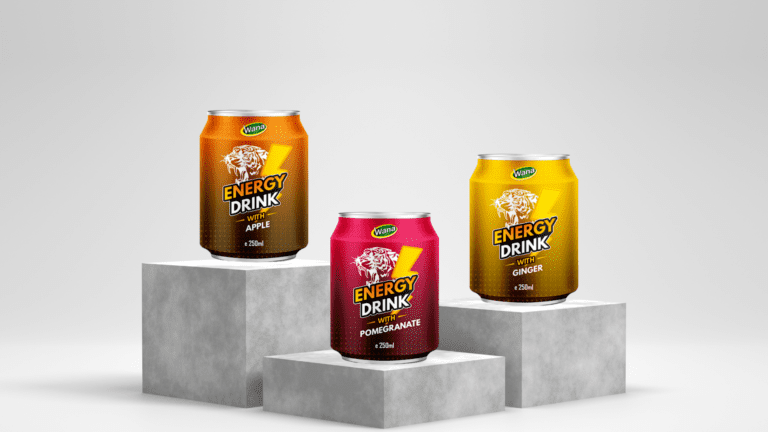
| Energy Drinks | Clean, plant-powered caffeine and functional focus |
Why WANA Beverage is Your Top Choice Manufacturing Partner in Vietnam
Selecting the right overseas co-packer determines whether your brand scales smoothly or faces costly delays at customs. WANA Beverage stands out at Vietnam’s premier OEM/ODM beverage manufacturing partner by combining large-scale automated production, strict international compliance and flexible contract terms designed specifically for US brand owners and importers.
- 5 Modern Manufacturing Facilities: Operating scalable production hubs equipped to process high-volume international OEM/ODM orders.
- 15+ High-Speed Production Lines: Automated filling and sealing lines engineered for precise quality control and maximum operational throughput.
- 15+ Packaging Options: Complete packaging versatility, including sleek, slim, and standard aluminum cans and PET bottles.
- 100+ New Formulas Developed/Year: An active in-house R&D team continuously innovating shelf-stable recipes aligned with US consumer flavor and ingredient trends.
- 200+ Global Brands Served: Trusted by international distributors, private label owners and retail chains to execute high-margin beverage SKUs.
- 60+ Countries Exported: Proven track record in managing global ocean freight logistics, import documentation and strict international food safety standard.
What are you waiting for? Connect with WANA Beverage today to discuss your beverage project for the United States market.