As consumers become increasingly environmentally conscious, packaging is no longer just about product protection—it has become a critical component of a company’s sustainability strategy.
The beverage industry, known for its high consumption volume and rapid growth, is facing growing pressure to reduce its environmental footprint. Among common packaging materials, glass bottles are often perceived as a “green” option. But is that perception entirely accurate?
This article takes a comprehensive look at the glass bottle environmental impact, examining every stage—from production and transportation to reuse and recycling—to provide a more realistic perspective for both businesses and consumers.
Glass Bottles environmental impact in the Beverage Industry
Glass bottles have been used for centuries and continue to hold a strong position in the beverage sector. From soft drinks and beer to juices and coconut water, glass is often chosen for premium product lines or brands positioning themselves as sustainable.
The reasons are clear:
🔸Chemically inert (no reaction with contents)
🔸Preserves original taste
🔸Reusable and recyclable
🔸Offers a premium look and feel
However, when it comes to environmental impact, the reality goes far beyond these surface-level advantages.
Production Process and Carbon Footprint
1. Raw Materials and Energy Consumption
Glass is made from natural materials such as:
🔸Silica sand
🔸Soda ash
🔸Limestone
While these materials are abundant, the challenge lies in the manufacturing process. Producing glass requires melting these materials at temperatures around 1,500°C, which is highly energy-intensive and typically relies on fossil fuels.
As a result:
🔸High CO₂ emissions
🔸Greater energy consumption compared to PET plastic or aluminum (in certain stages)
2. Quick Comparison
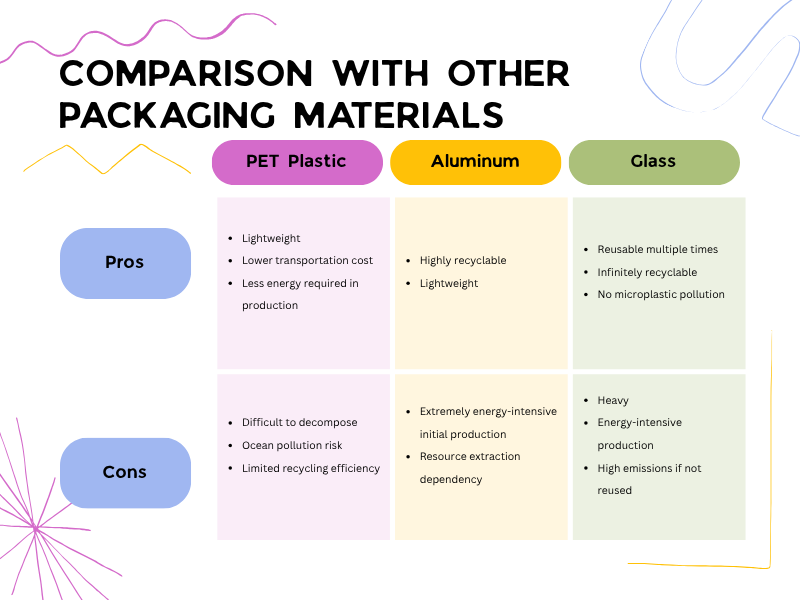
| Packaging Type | Energy Consumption | CO₂ Emissions |
| Glass | High | High |
| PET Plastic | Medium | Medium |
| Aluminum | Very high (initial) | High |
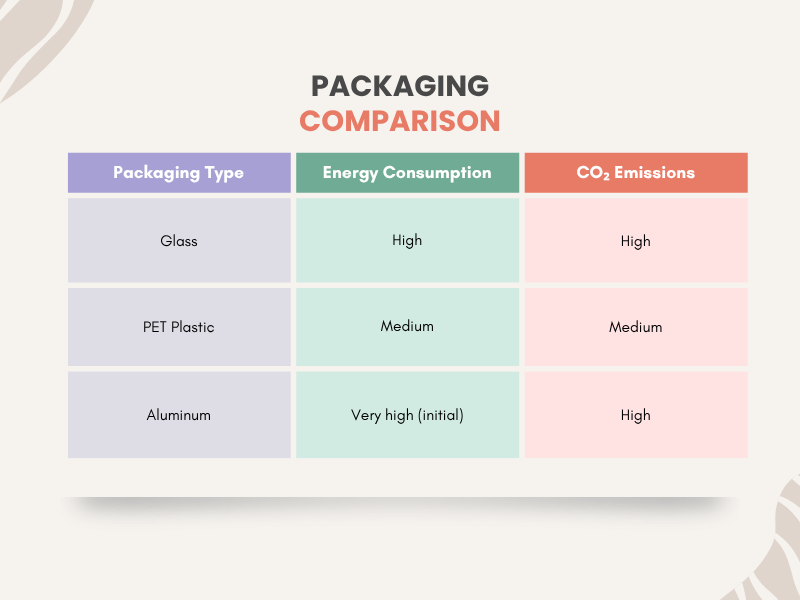
👉 If we look at production alone, glass is not the most environmentally friendly option.
Weight and Transportation Impact
One often overlooked factor is weight. Glass bottles are significantly heavier than plastic bottles or aluminum cans, which leads to:
🔹Higher transportation costs
🔹Increased fuel consumption
🔹Greater emissions in logistics
For example:
🔹A container filled with glass bottles can weigh nearly twice as much as one filled with plastic bottles
For beverage exporters, this is a critical factor that directly affects both cost and environmental impact.
Reusability: Glass’s Biggest Advantage
The strongest advantage of glass lies in its reusability. A single glass bottle can be:
🔹Cleaned
🔹Sterilized
🔹Refilled
This cycle can be repeated multiple times—typically 20 to 50 uses, depending on the system. So, environmental benefits are so many things:
🔹Reduces demand for new production
🔹Saves raw materials
🔹Lowers overall lifecycle emissions
In some European markets, deposit return systems (DRS) achieve recovery rates of over 90%. However, effectiveness depends heavily on:
🔹Collection infrastructure
🔹Consumer behavior
🔹Local policies
Recycling: Unlimited but Not Fully Optimized
Glass has a key advantage: it can be recycled infinitely without quality loss. But in practice:
🔹Recycling rates remain inconsistent across countries
🔹Collection and sorting systems are often inefficient
🔹Glass colors (clear, green, brown) must be separated
✅Benefits of Recycling
🔹Reduces melting temperature required
🔹Lowers energy consumption
🔹Decreases CO₂ emissions
Studies show that using just 10% recycled glass (cullet) can reduce energy consumption by 2–3% in production.
Comparison with Other Packaging Materials
Life Cycle Assessment – LCA
To properly evaluate environmental impact, experts use Life Cycle Assessment (LCA).
Findings for glass bottles:
🔹Single use: higher environmental impact than plastic
🔹Multiple reuse cycles: significantly lower impact, potentially better than plastic
Glass is only truly sustainable when reuse or efficient recycling systems are in place.
Perspective for Beverage Businesses
For beverage manufacturers, packaging decisions go beyond sustainability. They also involve:
🔹Production costs
🔹Brand positioning
🔹Consumer behavior
🔹Target markets
✅When to Choose Glass
🔹Premium product lines
🔹Markets with strong return systems
🔹Sustainability-focused branding
✅When to Reconsider
🔹Long-distance exports
🔹Single-use consumption products
🔹Markets with weak recycling infrastructure
Future Trends: Optimizing the Packaging Ecosystem Instead of Choosing the “Best Material”
For years, one of the most common questions in the beverage industry has been: “Are glass bottles better than plastic?” However, this way of thinking is gradually becoming outdated.
In reality, no single packaging material is perfect in every scenario. As a result, the industry is shifting away from isolated material comparisons toward optimizing the entire packaging ecosystem—from design and production to logistics, recovery, and reuse.
Below are the key trends shaping the future:
1. Lightweight Glass – Reducing Emissions from the Start
One of the most important innovations in the glass industry is lightweight glass—bottles that are lighter while still maintaining structural integrity.
✅What’s changing?
🔹Thinner bottle walls enabled by precision manufacturing technologies
🔹Structural optimization to reduce material usage without increasing breakage risk
🔹Use of digital simulation to test durability before production
✅Real-world impact:
🔹10–30% reduction in bottle weight
🔹Lower transportation costs
🔹Reduced fuel consumption in logistics
🔹Lower CO₂ emissions per unit
The key advantage is that light weighting does not change the user experience, yet significantly improves environmental performance. This is a “low behavioral change, high impact” solution, making it highly attractive for manufacturers.
2. Closed-loop Recycling – Moving Beyond Fragmented Systems
One of the biggest limitations of current recycling systems is fragmentation. Bottles may be collected, but they do not necessarily return to the original manufacturer. The concept of closed-loop recycling addresses this issue.
✅How it works:
- The company produces glass bottles
- Products are distributed to the market
- Consumers return bottles through a collection system
- Bottles are processed and recycled
- Materials are fed back into the same production system
✅Key benefits:
🔹Better control over recycled material quality
🔹Reduced reliance on virgin raw materials
🔹Long-term cost optimization
🔹Significant reduction in environmental waste
✅Challenges:
🔹Requires investment in collection infrastructure
🔹Depends on consumer participation
🔹Requires coordination across stakeholders (manufacturers, retailers, logistics providers)
When implemented effectively, this model creates a true circular system—not just recycling in theory.
3. Refillable Systems – A Classic Model, Reinvented
Refillable bottle systems were once widely used. Today, they are making a comeback—this time supported by modern technology and smarter operations.
✅What’s different today?
🔹Automated cleaning and sterilization processes
🔹Bottle lifecycle tracking via QR codes or RFID
🔹Optimized reverse logistics to reduce return costs
🔹Smart deposit systems to encourage returns
✅Environmental benefits:
🔹Significant reduction in new bottle production
🔹Lower emissions across the lifecycle
🔹More efficient resource utilization
✅Real-world applications:
🔹Returnable beer and soft drink bottles in Europe
🔹In-store refill systems (bring-your-own-bottle models)
🔹Direct-to-consumer (D2C) closed-loop distribution systems
Refillable systems only work effectively when fully integrated with distribution networks. If implemented in isolation, logistics costs may outweigh environmental benefits.
4. Hybrid Packaging – Combining Materials for Optimization
Instead of relying on a single material, many brands are adopting hybrid packaging—combining multiple materials to leverage their respective strengths.
✅Common examples:
🔹Glass bottles with lightweight aluminum caps
🔹Glass with protective coatings to reduce breakage
🔹Multi-layer packaging to reduce overall weight
🔹“Glass-like” composite materials
✅Objectives:
🔹Maintain the premium feel of glass
🔹Reduce weight and transportation costs
🔹Improve durability across the supply chain
🔹Enhance recyclability or reusability
✅Challenges:
🔹More difficult to recycle if materials are not easily separable
🔹Requires careful design from the outset to ensure circularity
👉 Hybrid packaging is only effective when designed with recycling or reuse in mind from the beginning.
5. Digitalization – The Invisible but Critical Driver
A less visible but highly impactful trend is digitalization in packaging management.
✅Key applications:
🔹Real-time tracking of bottle lifecycles
🔹Demand forecasting to optimize production
🔹Route optimization to reduce emissions
🔹Accurate measurement of carbon footprint
Digitalization enables companies to answer a critical question:
👉 “What is the true environmental impact of our packaging?”
With reliable data, businesses can:
🔹Adjust strategies quickly
🔹Optimize operational costs
🔹Meet increasingly strict ESG requirements
10. A Hidden Risk: Counterfeiting in Reuse Systems
While reuse offers environmental benefits, it also introduces risks—particularly product counterfeiting.
Glass bottles are durable and maintain their appearance, making them vulnerable to misuse:
🔹Refilling with low-quality products
🔹Re-sealing with counterfeit caps
🔹Re-entering the market as “authentic”
✅Impacts
🔹Loss of consumer trust
🔹Food safety risks
🔹Weakening of refill systems
✅Industry Solutions
🔹Tamper-evident caps
🔹Closed-loop collection systems
🔹QR codes and traceability
🔹Strict quality control
11. Wana Beverage’s Approach to Sustainability
At Wana Beverage, sustainability goes beyond simply choosing glass. The focus is on optimizing the entire packaging system:
🔹Tailored solutions for each market
🔹Strict quality control throughout production
🔹Strong emphasis on product safety and authenticity
This approach helps balance sustainability goals with real-world business efficiency.
12. Conclusion
Glass bottles are not a perfect solution—but neither are they inherently unsustainable. Their environmental impact depends on how they are used:
🔹Single use → high impact
🔹Reuse & efficient recycling → significantly lower impact
For the beverage industry, the challenge is not selecting the “best material,” but building the right system:
🔹Smart packaging design
🔹Optimized logistics
🔹Consumer participation in circular systems
Beyond recycling and emissions, companies must also consider:
🔹Lifecycle management
🔹Supply chain integrity
🔹Brand authenticity protection
Only by addressing all these factors can glass truly become a sustainable solution—not just in theory, but in practice. Ultimately, sustainability is not a single choice—it is the result of a well-optimized system.