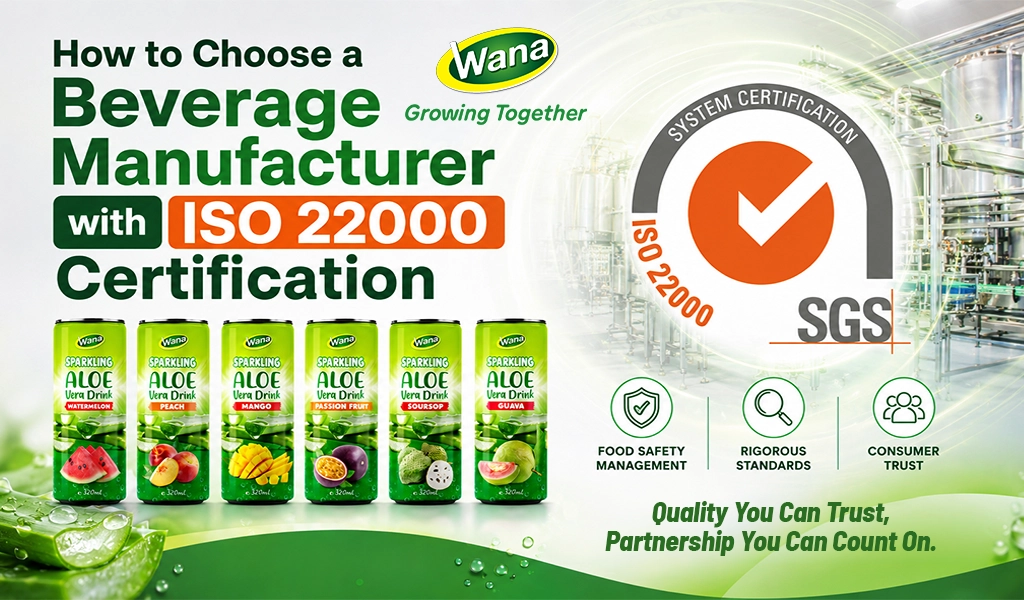
Choosing a beverage manufacturer ISO 22000 certified can be an important step for brands looking for reliable food safety and quality standards.
A beverage can look perfect on the outside. But what happens inside the factory matters even more.
For B2B buyers, choosing a manufacturer is not simply about comparing prices or production capacity. Food safety, product consistency, traceability, and regulatory compliance can directly affect your brand’s reputation and long-term success.
ISO 22000 provides a structured framework for managing food safety risks throughout the manufacturing process. However, certification alone does not automatically make a manufacturer the right partner for every beverage brand.
Buyers should also consider R&D capabilities, quality control, production capacity, export experience, and the manufacturer’s ability to meet specific product requirements.
In this guide, we’ll explore what to look for when choosing a beverage manufacturer ISO 22000 certified and the key questions B2B buyers should ask before starting a partnership.
What Is ISO 22000 Certification?
ISO 22000 is an international food safety management standard designed to help organizations identify, control, and manage food safety risks throughout the food supply chain. For beverage manufacturers, it provides a structured framework for managing potential hazards from raw material sourcing through production, packaging, and finished products.
For brands working with an ISO 22000 beverage manufacturer, the certification can provide greater confidence that food safety is managed through documented and controlled processes.
What Does ISO 22000 Cover?
ISO 22000 focuses on building a systematic approach to food safety rather than relying on final-product testing alone. Key areas include:
- Food safety management system – Establishes a structured system for managing food safety across the organization.
- Hazard identification – Identifies potential biological, chemical, and physical hazards that could affect product safety.
- Risk control – Defines preventive measures and controls to reduce food safety risks.
- Monitoring – Ensures critical processes and controls are regularly monitored.
- Corrective actions – Provides procedures for responding to problems and preventing them from happening again.
- Continuous improvement – Encourages manufacturers to regularly review and improve their food safety management systems.
For beverage brands, these processes are particularly important because product safety depends on many interconnected factors, including ingredients, processing conditions, equipment, hygiene, packaging, and storage.
ISO 22000 vs HACCP
ISO 22000 and HACCP are closely related, but they are not the same. HACCP primarily focuses on identifying and controlling food safety hazards, while ISO 22000 provides a broader food safety management framework.
| ISO 22000 | HACCP |
| Food safety management system | Hazard control system |
| More comprehensive management framework | Focuses on food safety hazards |
| Includes communication & management processes | Core focus is hazard analysis |
In simple terms, HACCP focuses on controlling food safety hazards, while ISO 22000 integrates hazard control into a broader management system.
For B2B buyers, understanding this difference can help when comparing beverage manufacturers and evaluating which food safety standards best match their sourcing and market requirements.
Why ISO 22000 Matters When Choosing a Beverage Manufacturer
For beverage brands, food safety is not something to consider only after production begins. It should be part of the decision when selecting a manufacturing partner.
An ISO 22000 beverage manufacturer has a structured food safety management system designed to identify and control potential risks throughout the production process. For B2B buyers, this can provide greater confidence in the manufacturer’s ability to manage food safety consistently.
Stronger Food Safety Management
ISO 22000 provides a systematic approach to identifying, monitoring, and controlling food safety hazards. This helps manufacturers manage risks across different stages of production, from raw materials to finished beverages.
More Consistent Production
Standardized procedures and controlled processes can help reduce variations between production batches. For beverage brands, this is important because consumers expect the same taste, quality, and product experience every time.
Better Traceability
Traceability allows manufacturers to track important information related to raw materials, production batches, and finished products. If a quality issue occurs, this information can help identify where the problem originated and support a faster response.
Proactive Risk Management
Rather than reacting to problems after they occur, ISO 22000 encourages manufacturers to identify potential food safety risks and establish appropriate controls in advance. This proactive approach can help reduce operational and product-related risks.
Greater Buyer Confidence
For importers, distributors, retailers, and brand owners, working with a manufacturer that follows an internationally recognized food safety management standard can provide an additional level of confidence.
However, certification should be viewed as one part of the evaluation process. Buyers should also consider the manufacturer’s R&D capabilities, production technology, quality control, export experience, and ability to consistently meet their specific requirements.
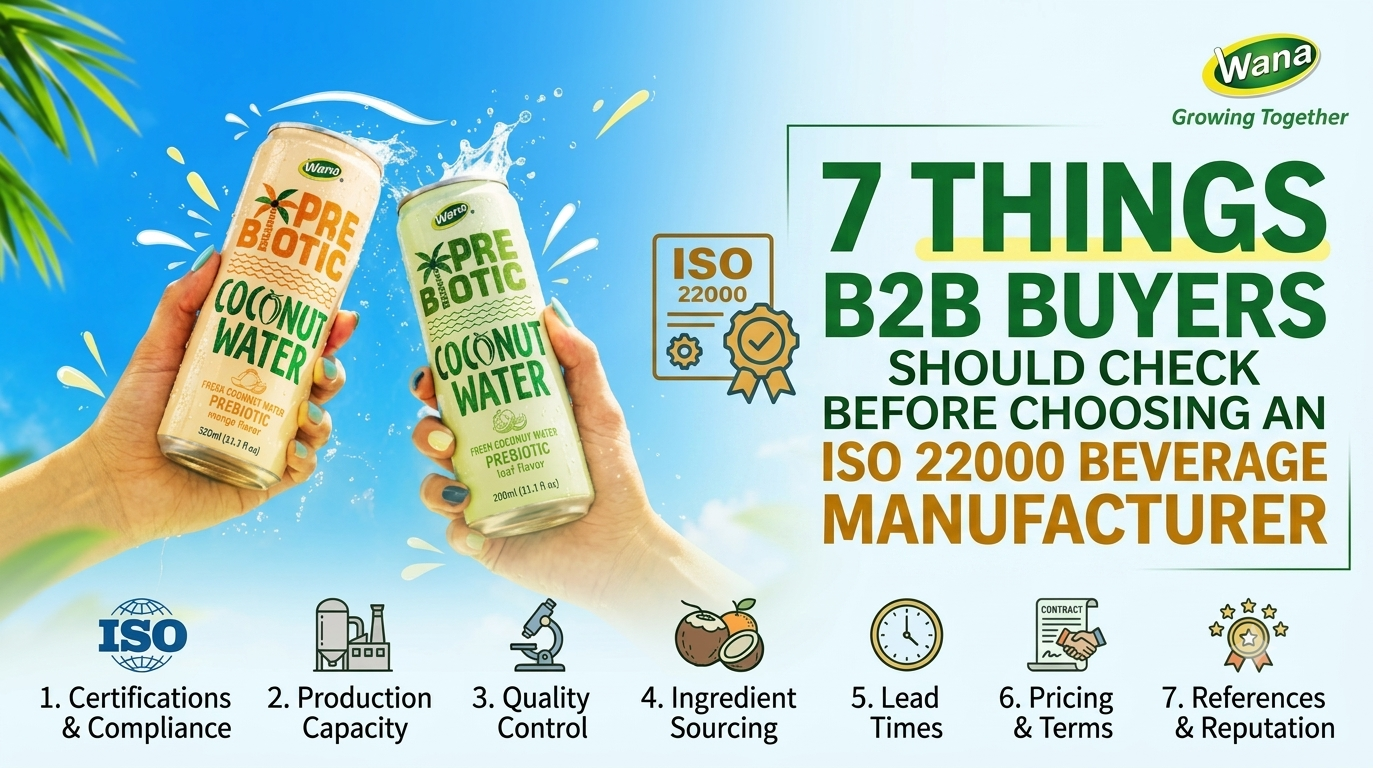
7 Things B2B Buyers Should Check Before Choosing an ISO 22000 Beverage Manufacturer
An ISO 22000 certificate is a good starting point, but it should not be the only factor you consider when choosing a beverage manufacturer. For B2B buyers, the right partner needs to combine food safety with product development expertise, reliable production, quality control, and export capabilities.
Verify the ISO 22000 Certification
Don’t simply ask whether a manufacturer is ISO 22000 certified. Ask to see the certification and check the details.
Pay attention to:
- Certificate validity
- Certification scope
- Manufacturing site
- Certification body
- Expiration date
The certification should apply to the actual facility producing your beverages and cover the relevant manufacturing activities.
Look Beyond Certification
Having ISO 22000 is important, but other certifications may also be relevant depending on your product and target market.
Consider whether the manufacturer also has:
- BRCGS
- FSSC 22000
- HACCP
- GMP
- FDA Registration
- HALAL
The goal is not to collect as many certificates as possible. Instead, look for standards that match your product, destination market, and business requirements.
Evaluate the Quality Control System
A certificate tells you that a management system is in place, but you should also understand how quality is managed in daily production.
Ask questions such as:
- How are raw materials inspected?
- How is production monitored?
- How are finished products tested?
- How are quality issues and non-conformities handled?
Strong quality control is essential for maintaining consistent taste, appearance, safety, and performance across different production batches.
Check Traceability and Batch Control
A reliable manufacturer should be able to trace products throughout the production process.
A typical traceability flow may look like:
Raw Materials → Production Batch → Packaging → Finished Product
This becomes especially important when dealing with a quality issue, customer complaint, or potential product recall. Good batch control allows problems to be identified and investigated more efficiently.
Evaluate R&D and Product Development Capability
ISO 22000 focuses on food safety management—it does not tell you whether a manufacturer can develop a great beverage.
For OEM and private label projects, evaluate the manufacturer’s R&D capabilities, including:
- Custom formulation
- Product sampling
- Formula optimization
- Stability testing
- Ingredient sourcing
- Scale-up from laboratory to commercial production
An experienced R&D team can help turn your initial beverage concept into a formula that is not only appealing to consumers but also suitable for large-scale production.
Check Manufacturing Capacity and Technology
Production capability matters just as much as certification, particularly if you expect your brand to grow.
Instead of asking only, “How much can you produce?”, look at the bigger picture:
- Production lines
- Filling technologies
- Packaging formats
- Level of automation
- Production scalability
- Equipment maintenance
The right manufacturer should have the technology and capacity to meet your current requirements while being able to support larger volumes in the future.
Consider Export Experience
If you plan to sell your beverages internationally, choose a manufacturer that understands the practical challenges of exporting.
Ask about:
- International documentation
- Labeling requirements
- Destination-market regulations
- Existing export markets
- Shipping experience
One important point to remember is that ISO 22000 does not automatically mean a beverage complies with every regulation in every country. Each market may have its own requirements for ingredients, labeling, testing, packaging, and registration.
An experienced export manufacturer can help you understand these requirements and prepare your product accordingly.
Read more: FSSC 22000 Beverage Manufacturer vs BRCGS: Which Certification Matters More?
Questions to Ask an ISO 22000 Beverage Manufacturer Before You Sign a Contract
Choosing a beverage manufacturer is a long-term decision. Before signing a contract, B2B buyers should go beyond pricing and production capacity and ask questions that reveal how well the manufacturer can support their product and business.
Here are eight practical questions to ask:
Can you provide a valid ISO 22000 certificate?
Ask to review the manufacturer’s current certificate and verify that it applies to the facility producing your beverages.
What is the scope of your certification?
The scope can help you understand which activities and products are covered by the certification. Make sure it is relevant to your project.
Which beverage categories do you manufacture?
Check whether the manufacturer has experience with your specific beverage category, such as fruit juice, sparkling drinks, coconut water, energy drinks, functional beverages, or other products.
What is your MOQ?
Minimum order quantity can have a significant impact on your launch budget and production planning. Ask whether the MOQ changes depending on the packaging format or product requirements.
How do you control batch-to-batch consistency?
Ask how the manufacturer monitors ingredients, production parameters, quality specifications, and finished products to maintain consistent quality.
Can you develop custom formulas?
If you have your own beverage concept, find out whether the manufacturer has an experienced R&D team that can support formulation, sampling, testing, and formula optimization.
Which international markets do you export to?
Export experience can be valuable when your target market has specific requirements for documentation, labeling, ingredients, testing, or product registration.
How do you handle product quality issues or complaints?
A reliable manufacturer should have a clear process for investigating quality issues, identifying the root cause, taking corrective action, and preventing similar problems in future production.
The answers to these questions can give buyers a much clearer picture of a manufacturer’s capabilities than a certificate or price quotation alone.
Read more: 10 Questions Every Brand Should Ask Before Choosing a Discreet Beverage Manufacturer
ISO 22000 Is Important—but It Shouldn’t Be Your Only Criteria
An ISO 22000 certificate is an important indicator of a manufacturer’s food safety management system, but it should not be the only reason you choose a beverage manufacturing partner.
For B2B buyers, selecting the right manufacturer requires looking at the bigger picture. A supplier may have the right certification but still lack the R&D expertise, production capacity, or export experience needed for your project.
A more complete evaluation should consider:
Certification + Quality + R&D + Capacity + Export + Communication + Reliability
Product Quality
Check how the manufacturer maintains consistent taste, appearance, safety, and product specifications from one batch to another. A strong quality control system should cover raw materials, production, packaging, and finished products.
R&D Capability
If you are developing a custom beverage, the manufacturer’s R&D team can make a significant difference. Look for experience in formulation, sampling, formula optimization, stability, and commercial scale-up.
Manufacturing Capacity
Your supplier should be able to meet your current production requirements and scale with your business. Production technology, filling systems, packaging options, and capacity should all match your product plans.
Export Experience
For international buyers, manufacturing is only one part of the process. Experience with export documentation, labeling, market requirements, and international logistics can make collaboration much smoother.
Communication and Reliability
Finally, consider how the manufacturer communicates and handles challenges. Clear communication, realistic timelines, transparent processes, and reliable support are essential for a long-term OEM partnership.
In simple terms, the right beverage manufacturer combines food safety with product quality, technical capability, production reliability, and business experience. ISO 22000 can be an important part of that equation—but it should never be the whole evaluation.
Why WANA Beverage Invests in International Food Safety Standards
At WANA Beverage, food safety is treated as part of the manufacturing process—not simply a certificate on the wall.
Our quality management approach covers the entire production journey, from raw material preparation and production to quality control, packaging, and finished products.
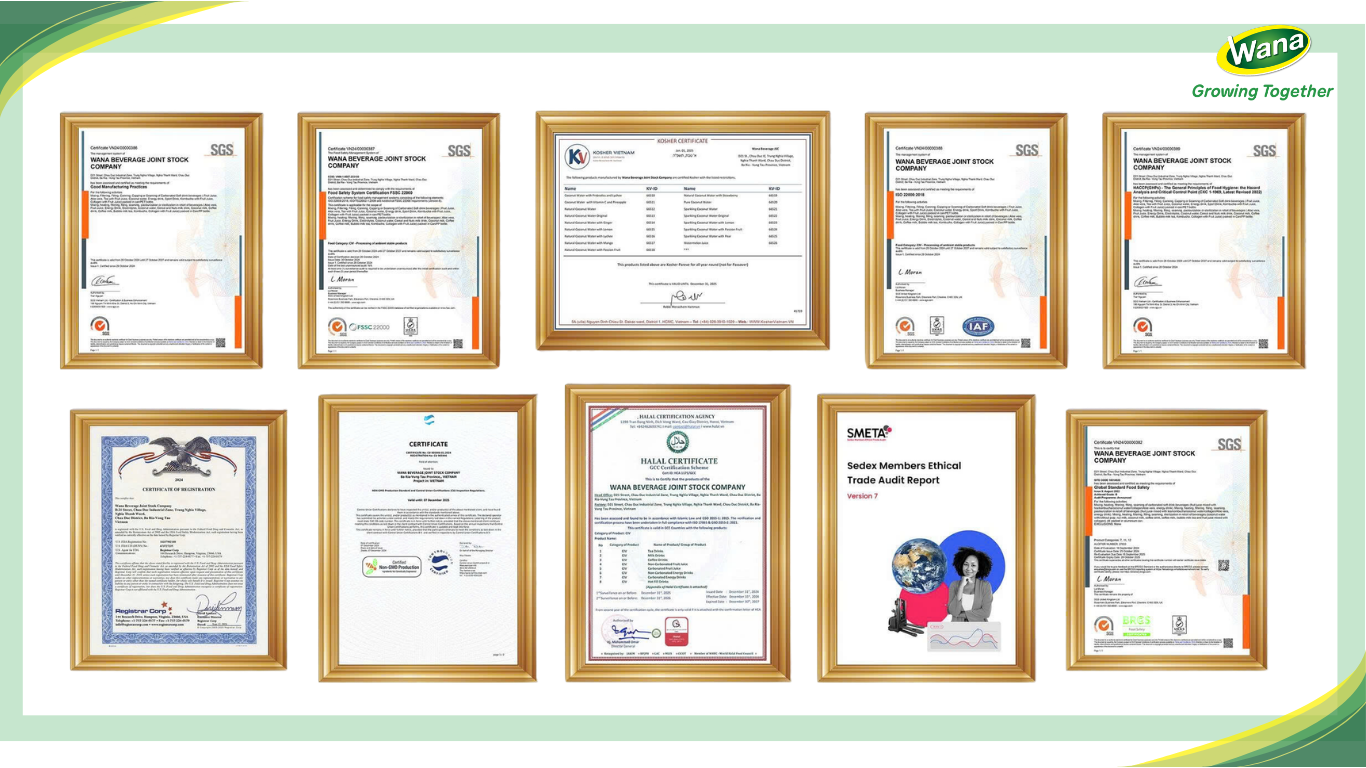
WANA Beverage maintains internationally recognized standards and certifications, including FSSC 22000, BRCGS, HACCP, ISO 22000, GMP, HALAL, and FDA Registration. Each standard supports different aspects of food safety, quality management, and market requirements.
Beyond certifications, our R&D and production teams work together to develop and manufacture beverages according to defined product specifications. This includes custom formulation, sampling, production control, and quality checks throughout the manufacturing process.
For global beverage brands, these systems provide a structured foundation for producing beverages with reliable quality and meeting the expectations of international buyers.
The goal is simple: build food safety and quality into the process from the beginning, rather than treating them as a final checkpoint.
 Frequently Asked Questions
 Frequently Asked Questions
Is ISO 22000 mandatory for beverage manufacturers?
ISO 22000 is not universally mandatory for beverage manufacturers. However, having this certification demonstrates that a manufacturer has a structured food safety management system. Requirements may also vary depending on the destination market, product category, and customer requirements.
Is ISO 22000 better than HACCP?
They serve different purposes. HACCP focuses primarily on identifying and controlling food safety hazards, while ISO 22000 provides a broader food safety management framework. Both can play an important role in beverage manufacturing.
Does ISO 22000 guarantee beverage quality?
No. ISO 22000 focuses on food safety management rather than guaranteeing every aspect of product quality. Buyers should also evaluate a manufacturer’s quality control, R&D capabilities, production processes, and batch consistency.
Does ISO 22000 help with beverage exports?
Yes, it can support international business by demonstrating that the manufacturer follows a recognized food safety management standard. However, ISO 22000 does not automatically mean a product meets every regulatory requirement in the destination country.
What is the difference between ISO 22000 and FSSC 22000?
Both are food safety management standards, but FSSC 22000 builds on ISO 22000 with additional sector-specific requirements and prerequisite programs. FSSC 22000 is also recognized by the Global Food Safety Initiative (GFSI).
Should I choose a beverage manufacturer with multiple certifications?
Multiple relevant certifications can be a positive sign, particularly when they match your target markets and product requirements. However, certifications should be considered alongside manufacturing capabilities, quality systems, R&D expertise, export experience, and reliability.
In Conclusion
ISO 22000 beverage manufacturer shouldn’t be about checking one certification box.
For B2B buyers, the right manufacturing partner should combine strong food safety management with consistent product quality, experienced R&D, reliable production capacity, effective traceability, and international export experience.
Before making a decision, verify the manufacturer’s certification, understand what it covers, and look beyond the certificate to see how quality and food safety are managed in practice.
Ultimately, the best partner is not simply the manufacturer with the most certifications. It is the one that can consistently deliver safe, high-quality beverages while supporting your product requirements and long-term business growth.