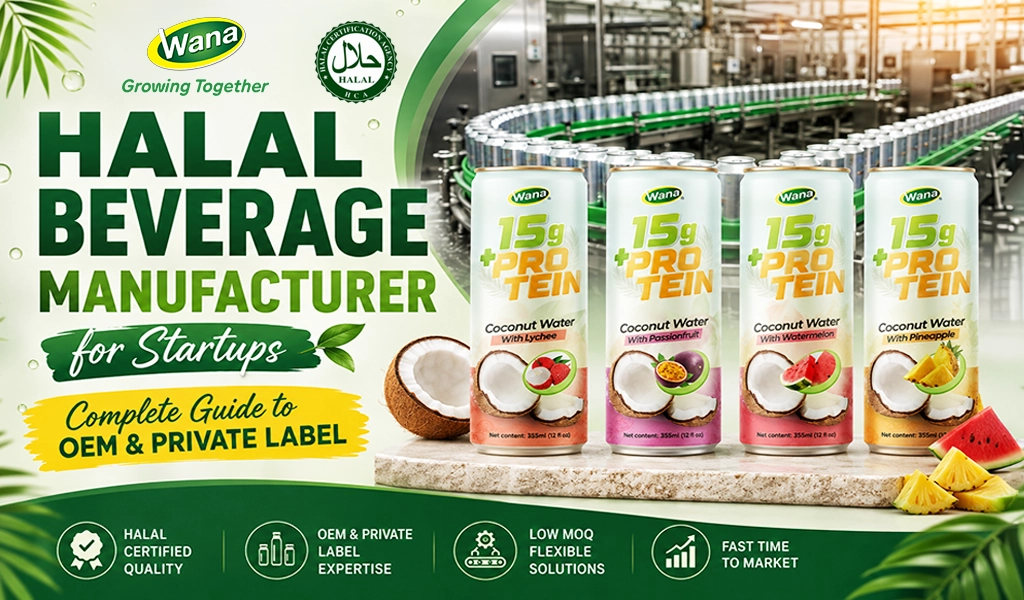
The global demand for HALAL beverages is creating new opportunities for startups looking to enter the growing beverage market. HALAL is no longer limited to Muslim consumers; many buyers also associate HALAL-certified products with transparent ingredients, controlled production, and trusted quality standards. For startups, this creates an opportunity to develop beverages that can appeal to a broader customer base while accessing markets across Southeast Asia, the Middle East, and other regions with growing demand for HALAL products.
However, launching a HALAL beverage requires more than a good product idea. Startups need the right ingredients, compliant production processes, suitable packaging, and a reliable HALAL beverage manufacturer. Working with an experienced OEM or private label partner can help simplify product development, reduce initial investment, and bring a new beverage brand to market more efficiently.
What Is a HALAL Beverage Manufacturer?
A HALAL beverage manufacturer is a beverage production partner that follows HALAL requirements throughout the manufacturing process, from ingredient sourcing and formulation to processing, packaging, storage, and handling. For startups, choosing a HALAL-compliant manufacturer is important when the goal is to sell beverages in Muslim-majority markets or reach consumers who specifically look for HALAL-certified products.
HALAL does not simply refer to the finished beverage. The entire production process must be carefully controlled to avoid prohibited ingredients or contamination. Manufacturers may need to review raw materials, processing aids, flavorings, additives, and other components used in the formula. Production equipment, facilities, storage areas, and handling procedures may also need to meet relevant HALAL requirements.
For a startup, this means working with a manufacturer that understands both beverage production and HALAL compliance. An experienced partner can help review ingredients, develop or adapt formulas, select suitable packaging, implement quality control procedures, and prepare products for certification and export.
Depending on the business model, startups can work with a HALAL beverage manufacturer through OEM, ODM, or private label production. This allows brands to access professional manufacturing capabilities without investing in their own production facility. By choosing the right manufacturing partner from the beginning, startups can build a HALAL beverage product that is suitable for their target market while maintaining consistent quality and production standards.
Why Startups Should Consider HALAL Beverages
HALAL beverages offer startups an opportunity to reach a growing consumer market while building a product positioned around quality, transparency, and trust. Although HALAL certification is particularly important for Muslim consumers, the demand for products that follow clear ingredient and production standards is expanding beyond Muslim-majority markets.
Access Growing Muslim Consumer Markets
The global Muslim population represents a significant consumer base across Southeast Asia, the Middle East, and other regions. Countries such as Indonesia, Malaysia, Saudi Arabia, and the UAE have established demand for HALAL-certified food and beverages. For startups, developing a HALAL beverage from the beginning can make it easier to target these markets and expand internationally.
Build Consumer Trust
HALAL requirements encourage careful attention to ingredients, processing, handling, and production practices. For a new beverage brand, demonstrating compliance with recognized HALAL standards can strengthen consumer confidence and provide an additional point of differentiation on the market.
Expand Market Opportunities
A HALAL beverage does not have to target only Muslim consumers. Startups can position HALAL certification alongside other product attributes such as clean-label ingredients, low sugar, natural flavors, or functional benefits. This creates flexibility to develop products for multiple consumer segments.
Simplify International Expansion
Working with an experienced HALAL beverage manufacturer can help startups prepare products for different export markets from the early development stage. With the right formulation, certification, packaging, and quality controls, a startup can build a beverage that is better prepared for regional and international distribution.
OEM vs. Private Label: Which Model Is Right for Your Startup?
When launching a HALAL beverage, startups can choose between different manufacturing models depending on their budget, product concept, customization needs, and target launch timeline. The most common options are OEM, ODM, and private label manufacturing. Understanding the differences can help founders select the right production partner and avoid unnecessary development costs.
Private Label Beverage Manufacturing
Private label is often a practical starting point for new beverage brands. The manufacturer typically provides existing beverage formulas or product concepts that can be adapted to the brand’s requirements. The startup can then customize elements such as flavor, packaging, bottle or can format, label design, and branding.
Because much of the product development work may already be completed, private label can help shorten the time from concept to market. It can be suitable for startups testing a new market or launching their first beverage with a limited initial investment.
OEM Beverage Manufacturing
OEM manufacturing offers greater customization. Instead of relying primarily on an existing product, the beverage is produced according to the brand’s specific requirements. Startups can work with the manufacturer’s R&D team to develop a particular flavor, ingredient profile, functional benefit, or nutritional specification.
OEM can be a better choice when a startup wants to create a more differentiated product and build a unique brand identity. However, customized development may require more time, testing, and investment than private label production.
ODM Beverage Manufacturing
ODM sits between product development and manufacturing. The manufacturer can provide product development expertise, including formulation and technical support, while the brand provides its market concept and branding direction.
| Manufacturing Model | Customization | Development Time | Suitable For |
| Private Label | Medium | Shorter | Market testing and new startups |
| OEM | High | Longer | Unique beverage concepts |
| ODM | High | Medium | Startups needing product development support |
For a HALAL beverage startup, the right model depends on how much customization is needed and how quickly the brand wants to enter the market. An experienced manufacturer can help evaluate these options and recommend the most suitable approach.
Read more: How to Create Your Own Drink Brand Without Building a Factory
How Does HALAL Beverage Manufacturing Work?
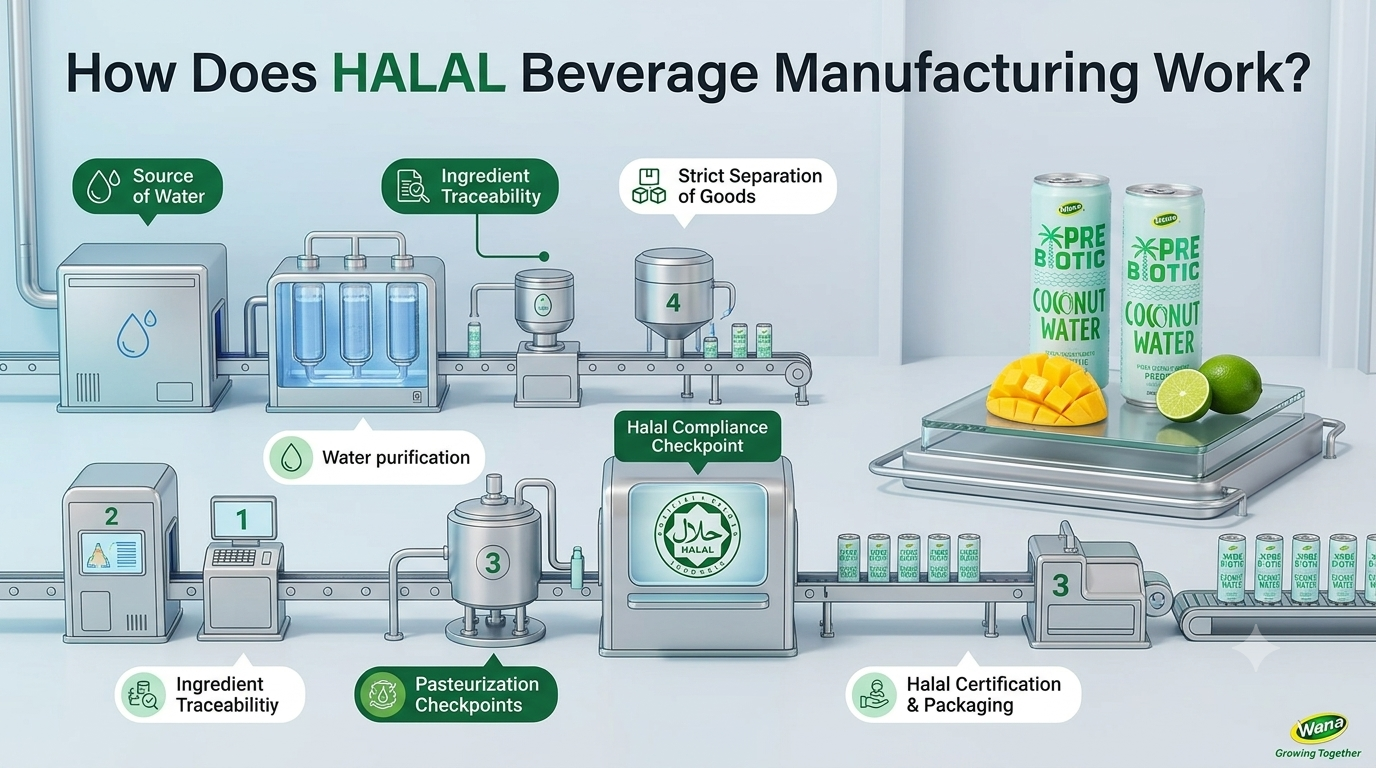
Producing a HALAL beverage involves more than simply selecting HALAL-certified ingredients. The manufacturer needs to maintain appropriate controls throughout product development and production to ensure the beverage meets applicable HALAL requirements. For startups, understanding the manufacturing process can make it easier to evaluate potential OEM or private label partners.
Ingredient Selection
The process begins with reviewing and selecting raw materials. Ingredients such as fruit concentrates, sweeteners, flavors, colors, functional ingredients, and processing aids should be evaluated for their HALAL status and suitability for the product formula. Manufacturers may request relevant documentation from suppliers to verify ingredient compliance.
Formula Development
Once suitable ingredients are identified, the R&D team develops or adjusts the beverage formula according to the startup’s concept. This may include flavor, sweetness, nutritional profile, functional benefits, and target market requirements. Samples are then tested and refined before moving to commercial production.
Processing and Production
Approved ingredients are processed according to the beverage’s formulation and production requirements. Depending on the product, this may involve mixing, filtration, pasteurization, carbonation, or other treatment processes. Proper hygiene and production controls are essential to maintain product quality and prevent contamination.
Filling and Packaging
The finished beverage is filled into the selected packaging format, such as PET bottles, aluminum cans, glass bottles, or cartons. Packaging materials, labels, and production handling should also comply with relevant requirements. Automated filling and sealing systems can help maintain consistency and production efficiency.
Quality Control
Quality control takes place throughout production, rather than only at the end. Manufacturers may monitor parameters such as taste, appearance, pH, Brix, microbiological safety, filling accuracy, and packaging integrity. Traceability and documented quality procedures are particularly important for export-oriented beverage brands.
HALAL Compliance and Certification
Depending on the target market and certification requirements, the manufacturer works with the relevant HALAL certification body to verify ingredients, production processes, facilities, and supporting documentation. Once the requirements are met, the beverage can be produced and marketed as HALAL according to the applicable certification.
For startups, partnering with a manufacturer experienced in HALAL beverage production can simplify this process and reduce the risk of compliance issues during product development and commercialization.
How to Choose the Right HALAL Beverage Manufacturer
Choosing the right HALAL beverage manufacturer is one of the most important decisions for a startup. The right partner can help you develop a compliant product, control production costs, and scale your brand as demand grows. Before signing a manufacturing agreement, consider the following factors.
HALAL Certification and Compliance
Start by checking whether the manufacturer holds a valid HALAL certification and whether its production processes meet the requirements of your target market. Ask about ingredient verification, production controls, traceability, and how HALAL compliance is maintained throughout manufacturing.
Food Safety Certifications
HALAL certification should be considered alongside food safety standards. Look for manufacturers with recognized certifications such as HACCP, GMP, BRCGS, or other relevant food safety systems. These certifications can provide additional assurance that the facility follows documented hygiene, quality, and safety procedures.
Manufacturing Capabilities
Evaluate whether the manufacturer can produce your specific beverage category. Depending on your concept, you may need capabilities such as hot filling, cold filling, pasteurization, carbonation, or specialized processing. A manufacturer with multiple production and packaging options can also make it easier to expand your product portfolio later.
MOQ and Startup-Friendly Production
Minimum order quantity (MOQ) is particularly important for startups with limited budgets or uncertain initial demand. Ask whether the manufacturer offers flexible production volumes and how MOQ varies according to packaging format, formula, and customization requirements.
R&D and Formulation Support
A strong R&D team can turn a beverage concept into a commercially viable product. Check whether the manufacturer can support formulation, ingredient selection, flavor development, nutritional targets, sample testing, and product optimization while considering HALAL requirements.
Packaging Options
Packaging can influence both brand positioning and production costs. Consider manufacturers offering different formats such as PET bottles, aluminum cans, glass bottles, or cartons, as well as various sizes and labeling options.
Quality Control and Production Capacity
Ask about the manufacturer’s QC procedures, laboratory capabilities, batch testing, traceability, and quality documentation. At the same time, evaluate production capacity to ensure the manufacturer can support your brand when order volumes increase.
Export Experience
If international expansion is part of your strategy, choose a manufacturer familiar with export documentation, international packaging requirements, and the regulations of your target markets. This experience can help reduce complications when moving from a local launch to international distribution.
For startups, the best HALAL beverage manufacturer is not necessarily the one offering the lowest price. A reliable partner should combine HALAL compliance, product development expertise, consistent quality, suitable MOQ, scalable production, and export capabilities to support your brand from its first production run to long-term growth.
Read more: How to Choose a Beverage Manufacturer in Vietnam: B2B Buyer Checklist
HALAL Beverage Manufacturing Costs and MOQ for Startups
Understanding manufacturing costs and minimum order quantities (MOQ) is essential for startups planning to launch a HALAL beverage. There is no single standard cost or MOQ because each project depends on the product concept, formulation, packaging, and production requirements.
Formulation and ingredients are among the main factors affecting product cost. A simple beverage using standard ingredients may require less investment than a customized formula containing premium, functional, or specialized ingredients. Additional R&D, laboratory testing, and sample development can also affect the initial development budget.
Packaging is another important cost factor. PET bottles, aluminum cans, glass bottles, and cartons have different production costs and MOQ requirements. Custom packaging, printed cans, specialized bottle shapes, and customized labels may require higher minimum volumes than standard packaging options.
Production volume also directly influences the unit cost. Larger orders can generally provide better economies of scale, while smaller production runs may have a higher cost per unit. Startups should therefore balance their initial MOQ with expected market demand and available budget.
Other costs may include HALAL certification, product testing, artwork and packaging development, logistics, and export documentation, depending on the project and target market.
When evaluating manufacturers, startups should ask for a clear quotation that separates product development, ingredients, packaging, production, certification, and logistics costs. A transparent cost structure makes it easier to compare suppliers and plan a realistic launch budget.
HALAL Beverage Categories Startups Can Launch
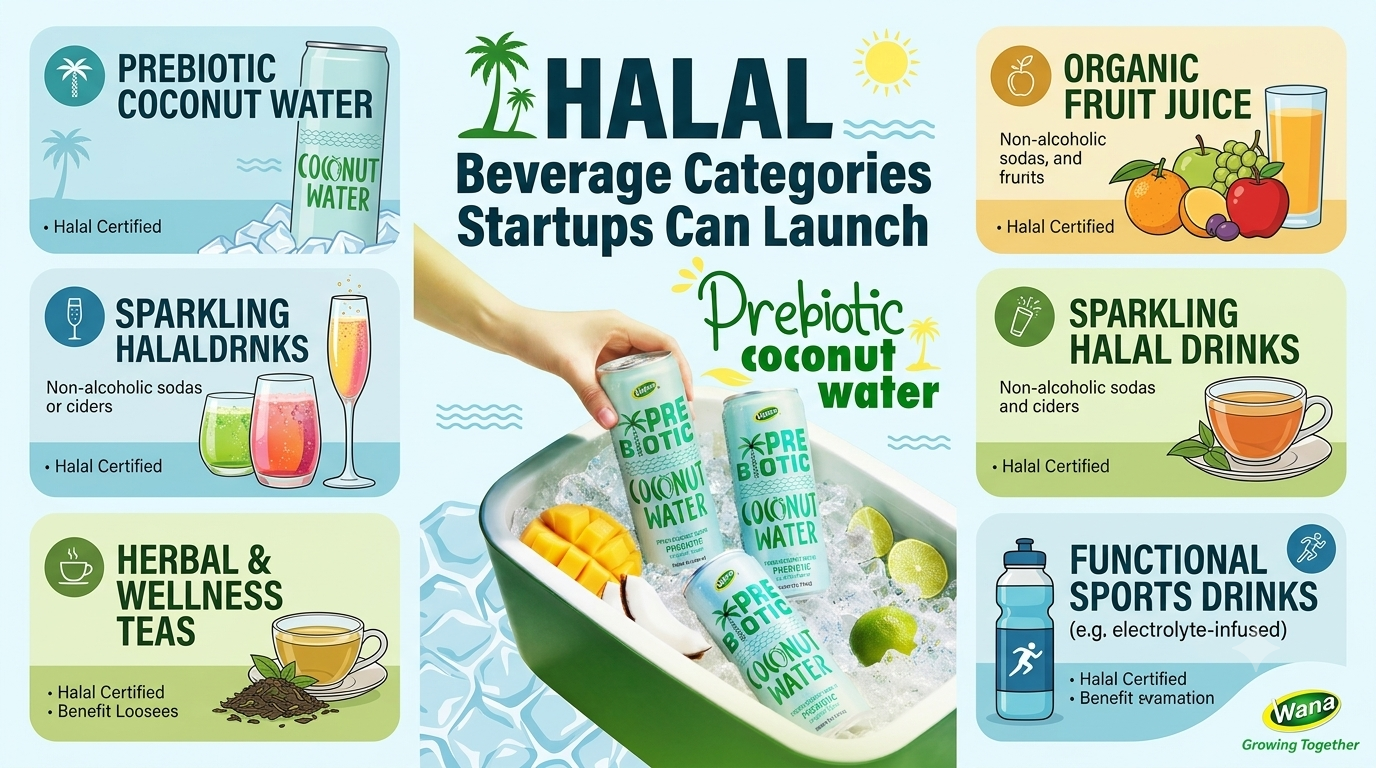
The HALAL beverage market offers startups a wide range of product opportunities, from simple refreshment drinks to functional and better-for-you beverages. Choosing the right category depends on the target consumer, market demand, positioning, and available production capabilities.
Coconut water is a strong option for brands targeting hydration and natural beverage trends. It can be offered as a single-ingredient product or developed with flavors and functional positioning.
Fruit juices and fruit-based drinks are another versatile category. Startups can explore flavors such as mango, pineapple, orange, guava, or mixed fruit, with options for low-sugar or clean-label positioning.
Sparkling beverages can provide a more modern and refreshing alternative to traditional soft drinks. Carbonated fruit drinks, sparkling water, and flavored sparkling beverages can be customized in different flavors and packaging formats.
For brands focused on wellness, functional beverages offer opportunities to incorporate ingredients associated with hydration, energy, digestion, or other consumer needs. Tea-based drinks, including iced tea and herbal beverages, can also appeal to consumers looking for lighter and refreshing options.
Meanwhile, energy drinks and sports or hydration beverages can target active consumers and younger demographics.
For startups, the key is not simply choosing a popular category, but finding a product concept that matches the target market and can be produced consistently under HALAL requirements.
From Beverage Idea to Market: The Startup Manufacturing Process
Launching a HALAL beverage typically involves several stages, from the initial product concept to finished goods ready for distribution. Working with an experienced OEM, ODM, or private label manufacturer can help startups manage these steps more efficiently.
Define the Beverage Concept
Start by identifying the target consumer, beverage category, flavor profile, nutritional positioning, packaging format, and target market. A clear concept gives the manufacturer a better foundation for product development.
Develop the Formula
The R&D team develops or adapts the beverage formula based on the startup’s requirements. Ingredients should be reviewed for suitability and HALAL compliance, while the formula is tested for taste, stability, and production feasibility.
Create and Test Samples
Prototype samples allow the brand to evaluate flavor, appearance, texture, sweetness, and overall product performance. Several rounds of adjustments may be required before approving the final formula.
Select Packaging and Develop Artwork
The startup chooses the appropriate bottle, can, carton, or other packaging format. Label artwork and required product information are then prepared according to the target market’s requirements.
Complete HALAL and Product Compliance
Relevant HALAL documentation and certification procedures should be completed based on the target market and applicable requirements. Other product testing and regulatory documentation may also be required.
Start Commercial Production
Once the formula, packaging, and compliance requirements are approved, the manufacturer proceeds with mass production, filling, sealing, labeling, and quality control.
Prepare for Shipment
Finished products are inspected, packed, palletized, and prepared for transportation. For export orders, the manufacturer and brand coordinate the necessary shipping and export documentation.
Following a structured process helps startups move from an initial beverage idea to a market-ready HALAL product while controlling development time, quality, and production risks.
Questions to Ask Before Choosing a HALAL Beverage Manufacturer
Before choosing a manufacturing partner, startups should evaluate more than price and MOQ. Asking the right questions early can help prevent production delays, unexpected costs, and compliance issues.
Do you have valid HALAL certification for beverage manufacturing?
Ask for certification details and confirm whether the certification is suitable for your target export market.
Can you help verify HALAL compliance for ingredients and formulas?
A capable manufacturer should be able to review ingredients, suppliers, processing aids, and formulation requirements.
What beverage categories and production technologies do you support?
Check whether the facility can produce your desired beverage and packaging format, such as juice, coconut water, sparkling drinks, functional beverages, or tea.
What is your MOQ for startup beverage brands?
Ask whether MOQ varies by formula, packaging type, customization level, or production line.
Do you provide R&D and formulation support?
If you have only a product concept, find out whether the manufacturer can support formula development, sampling, testing, and product optimization.
What quality and food safety certifications do you have?
In addition to HALAL certification, ask about standards such as HACCP, GMP, or BRCGS and how quality is controlled throughout production.
Can you support export and future production scaling?
If international expansion is part of your plan, choose a manufacturer with export experience and sufficient production capacity to support larger orders as your brand grows.
The right questions can help startups identify a manufacturing partner that is not only HALAL-compliant but also capable of supporting product development, consistent quality, and long-term growth.
Conclusion
Launching a HALAL beverage can give startups access to growing consumer markets while creating opportunities to build a trusted and differentiated brand. However, success depends on choosing a manufacturing partner that can support the entire journey—from formulation and ingredient selection to HALAL compliance, production, packaging, quality control, and export.
Whether you are developing a customized beverage through OEM/ODM or starting with a private label product, working with an experienced manufacturer can help reduce development complexity and bring your product to market more efficiently.
Ready to turn your HALAL beverage idea into a market-ready product? Talk to WANA Beverage to discuss your HALAL beverage concept, packaging requirements, and production volume.