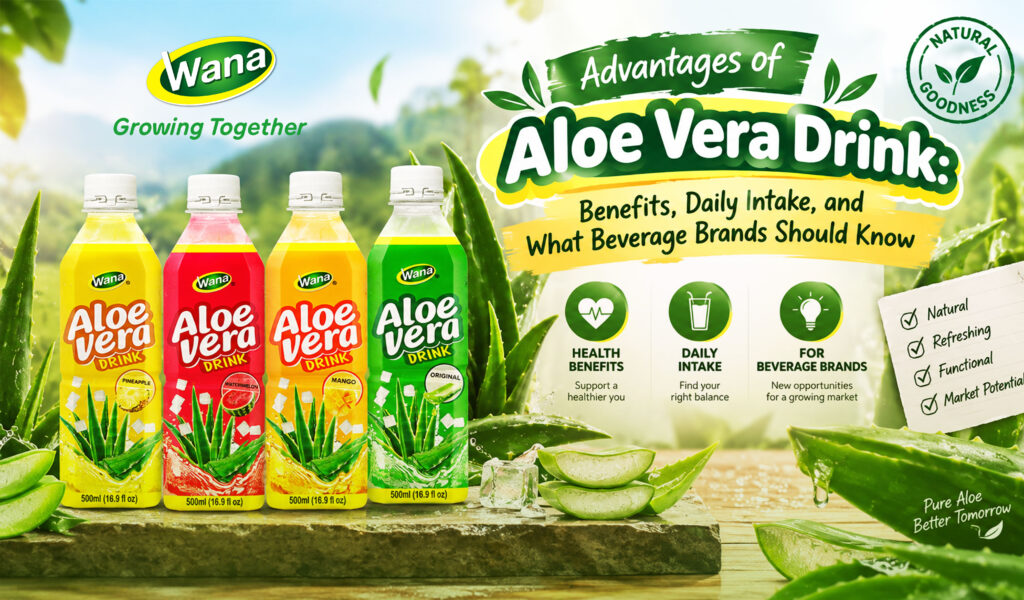
What is Aloe Vera Drink?
Aloe vera drink is a beverage made with aloe vera ingredients, typically derived from the inner gel of the aloe vera leaf. Depending on the formulation, the drink may contain aloe vera juice, gel, pulp, or aloe vera pieces, combined with water and other ingredients such as fruit juice, sweeteners, flavors, or functional ingredients.
The term “aloe vera drink” covers a broad range of products. Some beverages are formulated with aloe vera as the main ingredient, while others combine aloe vera with fruit flavors to create a more refreshing and differentiated drinking experience. Popular combinations include aloe vera with tropical fruits, citrus, berries, or other botanical ingredients.
It is also important to distinguish aloe vera drink from aloe vera juice. While the terms are sometimes used interchangeably, a finished aloe vera beverage can contain additional ingredients and undergo processing designed for taste, stability, safety, and shelf life. The type and processing of aloe vera used also matter because aloe products can be made from different parts of the leaf, including inner-leaf gel, latex, and whole-leaf preparations.
For beverage brands, this flexibility makes aloe vera a versatile ingredient for developing products across different formats and market positions, from refreshing fruit beverages to functional and wellness-oriented drinks.
Aloe vera drinks have attracted attention in the beverage market because they combine a distinctive ingredient with a wide range of formulation possibilities. However, the potential advantages of drinking aloe vera should be discussed carefully, as scientific evidence varies depending on the type of aloe preparation, dosage, and intended use.
What are the advantages of Aloe Vera Drink
A Distinctive Ingredient for Beverage Innovation
Aloe vera gives beverage brands an ingredient that is different from conventional fruit juice or soft drinks. Depending on the formulation, aloe vera can contribute juice, gel, pulp, or small pieces, creating opportunities for different textures and drinking experiences.
For brands looking to develop differentiated products, aloe vera can also be paired with fruit flavors such as strawberry, pineapple, peach, lemon, or tropical fruit.
Suitable for Wellness-Oriented Product Positioning
Aloe vera is widely associated with wellness and botanical beverages. This positioning can make aloe vera an interesting ingredient for brands developing products aimed at consumers interested in functional or plant-based beverage options.
However, beverage brands should avoid turning general associations with aloe vera into unsupported health claims. Research on oral aloe vera has shown some potential effects in specific contexts, but the overall clinical evidence remains limited and product-specific.
Flexible Formulation Opportunities
One advantage of aloe vera as a beverage ingredient is its compatibility with different formulation concepts. Brands can explore aloe vera with fruit juice, natural flavors, different sweetness levels, or other functional ingredients to create products for specific markets.
This flexibility can also extend to packaging formats, serving sizes, and product positioning, depending on the target market and manufacturing requirements.
A Convenient Way to Include Aloe Vera in a Beverage
A ready-to-drink aloe vera beverage offers a convenient format compared with consuming aloe vera ingredients separately. For consumers, the product can be designed as an easy-to-drink beverage with a familiar flavor and format.
From a product-development perspective, however, convenience does not automatically mean a product provides a particular health benefit. The final nutritional and functional profile depends on the ingredients, formulation, processing, and serving size of the finished beverage.
Overall, the advantages of aloe vera drinks are not limited to potential nutritional or wellness associations. For beverage brands, aloe vera can also provide opportunities for ingredient differentiation, flavor development, texture innovation, and the creation of new product concepts.
How Much Aloe Vera Juice Should You Drink Daily?
There is no single recommended daily amount of aloe vera juice that applies to every product. The appropriate amount depends on the type of aloe vera preparation, its concentration, other ingredients in the beverage, and the product’s intended use. For ready-to-drink beverages, consumers should follow the serving size and directions provided on the product label rather than applying a generic dosage to every aloe vera drink.
This distinction matters because aloe vera gel, aloe latex, and whole-leaf aloe products are not the same. According to the U.S. National Center for Complementary and Integrative Health (NCCIH), aloe products can be made from the inner-leaf gel, latex from the outer leaf, or whole crushed leaf. Oral aloe latex can cause abdominal pain, cramps, and diarrhea, while research suggests that short-term oral use of aloe gel for up to 42 days has been safe in studies.
Why this matters for beverage brands: Consumer questions around daily intake can influence serving size, packaging format, label communication and formulation decisions. Brands should therefore define serving recommendations based on the finished formula and applicable regulations rather than using a generic aloe vera dosage.
Is There a Standard Daily Serving?
Not necessarily. Clinical studies have investigated different aloe preparations and doses, so their findings should not be interpreted as a universal recommendation for commercial aloe vera beverages.
For example, one 12-week randomized, double-blind, placebo-controlled study involving 117 adults with impaired fasting glucose and overweight/obesity used a formulation containing aloe vera alongside pycnogenol and papain. Participants received 50 mL twice daily of the study formulation. Importantly, this was a specific multi-ingredient formulation—not a standard serving recommendation for aloe vera juice.
This is why beverage brands should be cautious when communicating daily intake or health benefits. The amount of aloe vera in a finished beverage can differ substantially from the amounts studied in clinical research.
What Should Consumers Consider?
For a commercially produced aloe vera drink, consumers should:
- Check the recommended serving size on the label.
- Follow the manufacturer’s consumption instructions.
- Check the ingredient list and the type of aloe preparation used.
- Avoid assuming that a higher amount provides greater benefits.
- Consult a healthcare professional before consuming oral aloe products if they take medication, are pregnant or breastfeeding, or have an underlying health condition.
NCCIH also notes that oral aloe may interact with some medicines and may not be safe during pregnancy or breastfeeding.
For beverage brands, this also highlights an important product-development consideration: daily serving size should be established based on the finished formulation, ingredient specifications, regulatory requirements, and intended market—not simply copied from a study using a different aloe preparation.
Read more: Discover 10 Aloe Vera Water Flavors for B2B Beverage Buyers
Why Are Aloe Vera Drinks Attractive to Beverage Brands?
Aloe vera drinks offer more than a familiar botanical ingredient. For beverage brands, they provide opportunities to develop products around ingredient differentiation, flavor innovation, and wellness-oriented positioning.
The category is also showing measurable commercial activity. Grand View Research estimates that the global aloe vera drinks market was valued at USD 131.7 million in 2024 and projects it to reach USD 254.8 million by 2030, representing a 11.7% CAGR from 2025 to 2030. Its analysis also found that Asia Pacific accounted for 32.7% of the market in 2024.
Another market analysis from Mordor Intelligence estimates that aloe vera juice/drink represented 72.15% of the aloe vera-based drinks market by revenue in 2025, while flavored products accounted for 56.70% of the market. The same report estimates PET bottles represented 73.88% of packaging share in 2025, while cans are projected to grow at an 11.39% CAGR through 2031.
These figures suggest several opportunities for beverage brands:
A Differentiated Beverage Ingredient
Aloe vera gives brands an ingredient that is visually and texturally different from conventional juice or soft drinks. Depending on the formulation, aloe vera can be incorporated as juice, gel, pulp, or small pieces.
This creates opportunities to develop beverages with a distinctive drinking experience rather than competing only through flavor.
Flexible Flavor Development
Aloe vera can be combined with fruit flavors to create different product concepts, including citrus, tropical fruit, berry, peach, or other flavor profiles.
Market data also indicates that flavored aloe vera drinks represent a significant part of the category. Mordor Intelligence reported a 56.70% revenue share for flavored variants in 2025, although the exact definition and methodology of each market report should be considered when comparing figures.
For private label brands, this flexibility can be useful when adapting a beverage concept to local consumer preferences.
Different Packaging Opportunities
Aloe vera drinks are not limited to one packaging format. PET bottles remain widely used in the category, while cans provide another option for brands seeking a more modern RTD presentation.
According to Mordor Intelligence, PET bottles accounted for 73.88% of aloe vera-based drink packaging share in 2025, while cans are projected to grow at 11.39% CAGR through 2031.
For B2B buyers, this means packaging can be considered alongside formulation, target market, serving size, and positioning rather than as a separate decision.
Opportunities for Functional and Wellness-Oriented Positioning
Aloe vera is already strongly associated with wellness and botanical beverages. This gives brands an opportunity to explore products positioned around refreshing, plant-based, or wellness-oriented consumption.
However, wellness positioning should not be confused with making medical claims. NCCIH states that there is still limited reliable evidence for many proposed oral uses of aloe vera, although some research suggests possible effects in specific areas such as blood glucose.
For beverage brands, the more sustainable approach is to build the product around ingredient transparency, formulation quality, taste, packaging, and compliant communication, rather than relying on unsupported health claims.
Potential for Private Label Product Development
The combination of ingredient differentiation, flavor flexibility, and multiple packaging options makes aloe vera suitable for customized beverage development.
For private label brands, the product can be adapted based on factors such as:
- Aloe vera content and format
- Fruit or botanical combinations
- Sweetness level
- Packaging format and size
- Target market requirements
- Shelf-life requirements
- Applicable certifications and regulations
This makes aloe vera not just an ingredient choice, but a potential platform for developing differentiated RTD beverage concepts.
Key Considerations When Developing a Private Label Aloe Vera Drink
Developing a private label aloe vera drink involves more than choosing a flavor and putting a brand name on the bottle. Beverage brands need to consider the aloe vera ingredient, formulation, processing method, packaging, regulatory requirements, and target market before moving into commercial production.
Aloe Vera Ingredient and Formulation
The first consideration is the type and form of aloe vera used in the beverage. Depending on the product concept, manufacturers may work with aloe vera juice, gel, pulp, or aloe vera pieces.
The formulation should also be developed around the desired taste, texture, sweetness, and serving format. For example, a beverage with visible aloe vera pieces requires different formulation and processing considerations from a clear aloe vera drink.
Brands should also avoid assuming that a higher aloe vera content automatically means a better product. The right formulation needs to balance ingredient level, taste, texture, stability, cost, and the requirements of the target market.
Flavor and Product Positioning
Aloe vera has considerable potential for flavor development. Brands can combine it with fruit or botanical ingredients to create different product concepts, such as aloe vera with tropical fruits, citrus, berries, or other complementary flavors.
For private label development, flavor selection should reflect the target market rather than simply following current trends. A distributor targeting convenience stores may have different requirements from a brand developing a premium wellness beverage.
Processing and Shelf Life
Processing technology plays an important role in maintaining product safety, quality, and stability throughout the intended shelf life.
The appropriate processing and filling method depends on the formulation, packaging material, product characteristics, and required shelf life. These factors should be validated during product development rather than determined solely by the packaging format.
Shelf life should also be supported by appropriate stability and quality testing. A supplier should be able to explain how the proposed shelf life is established and what quality controls are performed during production.
Packaging Format
Packaging is another important decision for private label beverage development. PET bottles, aluminum cans, and other formats can create different positioning, logistics, and cost considerations.
The choice should take into account the target sales channel, serving size, transportation conditions, filling technology, and expected shelf life.
For brands exporting to markets such as the United States, labeling requirements should also be reviewed early in the development process. For example, the U.S. FDA requires certain beverages that purport to contain fruit or vegetable juice to declare the percentage of juice, while the labeling requirements can vary depending on the product and claims made.
Food Safety and Regulatory Requirements
A private label beverage must meet the food safety and labeling requirements of its destination market. This includes reviewing the ingredients, additives, packaging materials, nutrition information, product claims, and required label statements.
The aloe vera ingredient itself also requires careful attention. FDA enforcement has shown that businesses should not automatically describe an aloe vera product as a “vegetable juice” simply because aloe vera is botanically a plant. Product naming and labeling need to comply with the applicable regulatory definitions.
For export-oriented brands, working with a manufacturer that understands the requirements of the destination market can help reduce compliance issues before production begins.
MOQ, Cost, and Production Capacity
Commercial planning should start before the final formulation is approved. Brands need to understand the manufacturer’s MOQ, packaging minimums, formulation costs, production capacity, lead time, and expected cost per unit.
MOQ can vary depending on the packaging format and formulation. Custom packaging may also affect the minimum order quantity. Buyers should look beyond the lowest MOQ. They should also consider quality consistency and whether the supplier can support larger orders as the product grows.
Quality Control and Supplier Capability
Finally, choosing the right supplier is essential. A private label beverage manufacturer should have strong food safety and quality control systems. It should also have suitable production capabilities and export experience for the target market.
Before placing an order, beverage brands should ask about:
- Ingredient specifications and sourcing
- Formulation and R&D capabilities
- Production and filling technology
- Quality control and testing
- Food safety certifications
- Packaging capabilities
- Export documentation
- MOQ and production lead time
- Sample and product approval process
Choosing a manufacturer with support across formulation, production, and export can simplify product development. It also helps brands maintain better control over quality and consistency throughout the process.
Read more: Beverage OEM Supplier Confidentiality: How Manufacturers Protect Your Formula
Frequently Asked Questions About Aloe Vera Drink
Is Aloe Vera Drink Good for You?
Aloe vera drinks can be part of a balanced diet. Their nutritional value and potential benefits vary by product. This depends on the aloe vera content and overall formulation. Aloe vera is widely associated with wellness, but scientific evidence for many oral health benefits remains limited. Consumers should check the ingredient list and nutrition information of each product.
Is Aloe Vera Drink the Same as Aloe Vera Juice?
Not necessarily. “Aloe vera juice” may refer to a beverage ingredient or a finished juice product, while “aloe vera drink” can contain additional ingredients such as water, fruit juice, sweeteners, flavors, or other functional ingredients. Aloe vera products can also differ depending on whether they use inner-leaf gel, latex, or whole-leaf preparations.
Can I Develop a Private Label Aloe Vera Drink?
Yes. Beverage brands can work with an OEM/ODM or private label manufacturer to develop an aloe vera beverage based on their desired formulation, flavor, packaging, and target market. The development process typically involves product formulation, sampling, testing, packaging selection, production, quality control, and regulatory review.
What Should I Look for in an Aloe Vera Drink Manufacturer?
Look for a manufacturer with relevant beverage R&D capabilities, food safety systems, quality control procedures, suitable production and filling technology, flexible packaging options, and experience with your target export market.
It is also important to clarify MOQ, lead time, formulation ownership, certifications, testing, and export documentation before starting commercial production.
How Do I Start a Private Label Aloe Vera Drink?
Start by defining your target market and product concept. Choose your preferred flavor and packaging format. Then, work with an experienced beverage manufacturer to evaluate the formulation. The manufacturer can help develop samples, select packaging, and move the approved product into commercial production.
Launch Your Private Label Aloe Vera Drink with Wana Beverage
Turning an aloe vera beverage concept into a market-ready product requires more than manufacturing capacity. It requires the right combination of formulation, processing, packaging, quality control, and export support.
At Wana Beverage, we provide OEM, ODM, and private label beverage solutions to help brands develop aloe vera drinks based on their product concept and target market.
From recipe development and R&D to beverage manufacturing, packaging, quality control, and export support, our team can work with you throughout the product development process.
You may want to develop an aloe vera drink with pulp. You may also have a new fruit-flavored concept or need customized packaging. Wana Beverage can help turn your beverage idea into a market-ready product.
Wana Beverage operates under internationally recognized food safety and quality standards, including BRCGS, FSSC 22000, ISO 22000, HACCP, GMP and HALAL, and supports FDA-related registration and compliance requirements for products destined for the U.S. market.
Have an aloe vera beverage idea?
Talk to Wana Beverage about your formulation, packaging, target market, and production requirements.